Blog
Learning Materials
Female hairline types: patterns, care, and 5 key facts
Updated: April 17, 2026

TL;DR:
- Most women have natural variations like widow's peaks and lateral mounds, making "perfect" hairlines a myth.
- Knowing your specific hairline type helps tailor styling, care routines, and health monitoring.
- Hairlines can change over time due to age, hormones, or stress, so regular tracking is essential.
Most women assume their hairline is either "normal" or somehow off. The reality is far more interesting. 81% of women have a widow's peak and 98% have lateral mounds, meaning the so-called "perfect" hairline is actually a myth backed by zero data. Female hairlines come in a surprising range of shapes, depths, and patterns, all of which are completely natural. Once you understand your own hairline type, you gain real power over how you style your hair, how you care for it, and how you respond to changes over time. This article breaks all of that down clearly.
Table of Contents
- What defines a female hairline?
- Common types of female hairlines
- How hairline types impact appearance and hair care
- Growth tracking, health, and changing hairlines
- Why embracing your unique hairline matters more than chasing perfection
- Next steps: Personalized hairline analysis and care
- Frequently asked questions
Key Takeaways
| Point | Details |
|---|---|
| Hairline types are diverse | Research shows most women have unique patterns, not just one standard shape. |
| Shapes influence care | Different hairline types require tailored styling and health routines. |
| Monitoring is valuable | Tracking your hairline helps catch changes early for better long-term hair health. |
| Embrace individuality | Accepting your natural hairline boosts confidence and supports healthier practices. |
What defines a female hairline?
Your hairline is the boundary where your hair meets your forehead, but it is far more detailed than that single edge. Dermatologists and surgeons map it using specific anatomical landmarks, and knowing these helps you understand what you are actually looking at when you examine your own hair.
The three main zones of a female hairline are:
- Frontal midpoint: The center-most point of the hairline, directly above the nose bridge.
- Lateral mounds: Slight rounded projections on either side of the frontal midpoint, present in nearly all women.
- Temporal peaks: The areas where the hairline curves toward the temples, often showing the most variation between individuals.
Measurements matter here. The mean mid-eyebrow to frontal midpoint distance is 5.5 cm in women, which gives surgeons and hair specialists a baseline for what is considered proportionate. But proportionate does not mean identical. That 5.5 cm is an average, not a rule.
| Landmark | Location | Why it matters |
|---|---|---|
| Frontal midpoint | Top center of forehead | Defines overall hairline height |
| Lateral mounds | Sides of frontal midpoint | Creates natural framing curve |
| Temporal peaks | Near temples | Affects face width perception |
| Widow's peak | V-shaped dip at center | Adds definition, very common |
Understanding these zones also helps when recognizing hairline types and assessing whether changes you notice are structural or related to thinning. For example, a naturally high frontal midpoint looks very different from a receding one, even if the measurement is similar.
The shape of your hairline directly frames your face. A lower, rounder hairline can make the forehead appear smaller and softer. A higher or more angular hairline elongates the face visually. Neither is better. They are just different, and each responds differently to styling and care. Knowing the anatomy behind female hairline causes and structure gives you a much sharper lens for evaluating your own hair health.
Common types of female hairlines
With the anatomy in place, the next step is recognizing which category your hairline falls into. Research from a Japanese study identified four main frontal hairline patterns and four temporal patterns in women, giving us a solid, evidence-based framework to work from.
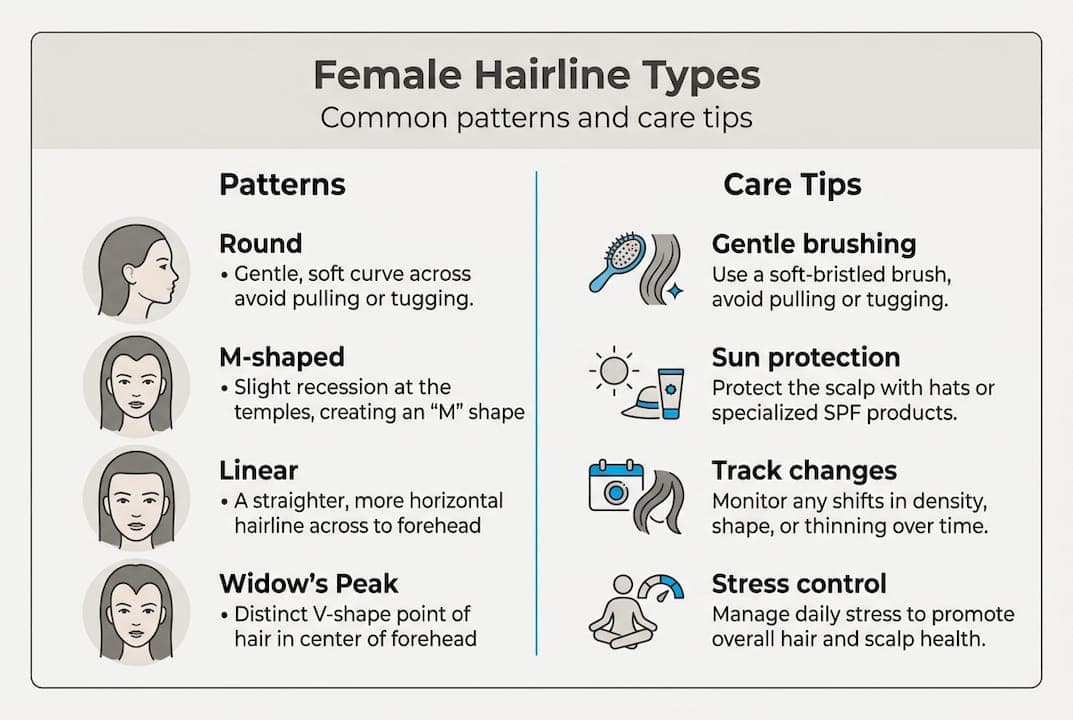
The four frontal hairline types are:
- Round: A smooth, curved line across the forehead. The most common type, found in 38.5% of women.
- Linear: A relatively straight horizontal line. Present in 36.1% of women and often associated with a broader forehead appearance.
- M-shaped: Two slight peaks with a gentle curve between them, seen in 18.2% of women. Often confused with early recession, but it is a natural shape.
- Triangular: A more pointed central peak, the least common frontal type.
For the temporal region, the patterns include inverted triangle, straight, convex, and inverted round shapes. These affect how the hairline transitions from the front toward the ears and can significantly influence how a hairstyle frames the sides of the face.
| Frontal type | Prevalence | Key visual feature |
|---|---|---|
| Round | 38.5% | Smooth, soft curve |
| Linear | 36.1% | Flat, horizontal edge |
| M-shaped | 18.2% | Two gentle peaks |
| Triangular | Least common | Pointed central peak |
The widow's peak, that distinct V-shaped dip at the center, appeared in 29.6% of women in this study. That contrasts with other population data showing rates as high as 81%, which tells you that prevalence varies significantly by ethnicity and measurement method. It is not rare. It is not unusual. It is just one of many normal variations.

Pro Tip: If your hairline looks M-shaped, do not immediately assume it is thinning. Compare it to photos from a few years ago. A naturally M-shaped hairline stays consistent, while recession shows a clear shift in the hairline position over time.
Knowing your frontal type helps when exploring female hairline types in more detail. You can also look into middle hairline types or straight hairline types to narrow down your specific pattern and understand what styling approaches suit it best.
How hairline types impact appearance and hair care
Knowing your hairline shape is useful on its own, but the real value comes from applying that knowledge to how you look and how you care for your hair every day.
Different hairline shapes create very different visual impressions:
- Round hairlines soften angular face shapes and work beautifully with center parts or curtain bangs that follow the natural curve.
- Linear hairlines create a clean, structured look. Blunt bangs or sleek updos emphasize this shape in a striking way.
- M-shaped hairlines add natural dimension. Side parts that lean into one of the peaks can make this shape look intentional and stylish rather than uneven.
- Triangular hairlines draw the eye to the center of the forehead. Soft, face-framing layers balance this well.
"Your hairline is not a flaw to fix. It is a structural feature to work with. The most flattering hairstyles are the ones that honor what is already there."
Beyond styling, your hairline type also signals where you need to pay extra attention in your care routine. Temporal recessions are concave triangular or oval in 87% of women, which means the temple area is naturally thinner and more vulnerable to stress from tight hairstyles, heat, and friction.
Here are practical care strategies based on hairline type:
- Avoid tight ponytails or braids that pull at the temporal hairline, regardless of your frontal shape.
- Use a wide-tooth comb near the hairline when detangling to reduce breakage at the edges.
- Apply a lightweight scalp serum along the hairline two to three times per week to support follicle health.
- If you notice your hairline shifting, check out solutions for thinning hairlines before the change becomes harder to address.
Pro Tip: Take a close-up photo of your hairline in natural light every three months. Small shifts are almost impossible to notice day-to-day but become obvious when you compare photos side by side.
For a more structured evaluation, a hairline analysis can map your specific pattern and flag any early signs of change that you might miss on your own.
Growth tracking, health, and changing hairlines
Hairlines are not fixed. They shift with age, hormones, stress, and health, and the earlier you catch a change, the more options you have for addressing it.
The most reliable way to track your hairline is through consistent measurement and documentation. Mean distances for lateral mounds and frontal midpoint can be tracked over time to detect gradual recession or density changes that would otherwise go unnoticed.
Here is what a solid tracking routine looks like:
- Monthly photos: Same lighting, same angle, same distance from the mirror every time.
- Tape measure check: Record the distance from your mid-eyebrow to your frontal midpoint every three months.
- Density notes: Note whether the hairline edge looks full and defined or sparse and uneven.
- App tracking: AI-powered tools can compare scans over time and flag changes with far more precision than the naked eye.
Common causes of hairline shifts in women include postpartum hair loss, chronic stress, thyroid dysfunction, traction alopecia from tight styling, and age-related hormonal changes. Not all of these are permanent, but all of them benefit from early attention.
Pro Tip: If you notice your part getting wider near the hairline or see more scalp visible at the temples, do not wait six months to act. These are early signals worth investigating now, not later.
When changes are caught early, the range of effective responses is much wider. This is exactly why growth tracking solutions focus on building a consistent baseline first. Without a baseline, you have no reference point, and without a reference point, you are guessing.
The goal is not to obsess over your hairline. It is to stay informed enough that nothing sneaks up on you.
Why embracing your unique hairline matters more than chasing perfection
Here is something the beauty industry rarely tells you: the data does not support the idea of a single ideal female hairline. Nearly every woman has lateral mounds or a widow's peak, which means the features most often labeled as "imperfections" are actually the statistical norm.
When women compare their hairlines to filtered images or surgical ideals, they are measuring themselves against a standard that does not exist in nature. That is not a beauty insight. That is a marketing strategy.
The more useful framework is this: understand your hairline type, learn how it frames your face, track it for health reasons, and care for it accordingly. That approach builds real confidence because it is grounded in your actual biology, not someone else's edited photo.
We have seen, through hairline research insights, that diversity in hairline shape is not a bug in human biology. It is the feature. The women who feel most at ease with their hair are almost always the ones who stopped chasing a different hairline and started working with the one they have.
That shift in perspective is not just emotional. It is practical. When you stop trying to hide your natural hairline, you make better styling choices, you stress your edges less, and you notice real health changes faster because you are actually paying attention.
Next steps: Personalized hairline analysis and care
Understanding your hairline type is a strong foundation, but personalized analysis takes it further. Patterns that look similar on the surface can behave very differently depending on your hair density, growth cycle, and scalp health.
MyHair.ai uses AI-powered scanning to give you a detailed picture of your hairline and overall hair health, not just a general category. The personalized hair analysis maps your specific pattern, tracks changes over time, and connects you with product recommendations tailored to your actual needs. You can also use the AI hair scanner for a quick assessment, or if you prefer a clinical setting, explore the clinic hair onboarding option for a more guided experience. Your hairline is unique. Your care plan should be too.
Frequently asked questions
Which female hairline type is most common?
According to research, round and linear frontal hairlines are the most common types, with round at 38.5% and linear at 36.1%, followed by M-shaped at 18.2%.
Can female hairlines change over time?
Yes, hairlines can shift due to genetics, aging, hormonal changes, or stress. Tracking hairline distances over time is one of the most reliable ways to catch early changes.
How can I identify my hairline type?
Compare your hairline shape to the four main patterns (linear, round, M-shaped, triangular) using a mirror and natural light. Detailed guides on identifying hairline types can help you match your specific shape.
Is a widow's peak rare in women?
Not at all. Studies show a widow's peak appears in 29% to 81% of women depending on the population studied, making it one of the most common hairline features.
Recommended
- Female Hairline: Causes, Growth Tracking, and Solutions for 2025 | MyHair
- Male Hairlines in 2025: Causes, Patterns, and Best Solutions | MyHair
- Normal Hairline for Men: What It Looks Like | MyHair
- M Hairline 2025: Essential Guide to Styling & Care | MyHair
- Hot Oil Hair Growth Treatment. – ZenChemy Lab