Blog
Learning Materials
Hair Breakage Causes: What's Really Damaging Your Hair
Updated: May 19, 2026

TL;DR:
- Hair breakage results from structural damage and nutritional deficiencies rather than just washing habits or product use. Differentiating breakage from shedding and thinning is essential for applying correct treatment strategies. Reducing heat exposure, restoring moisture, and addressing internal health issues are key to preventing and repairing hair breakage effectively.
Most people assume broken strands mean they need to wash their hair more carefully or buy a fancier shampoo. The real story is far more specific. Hair breakage causes range from structural damage at the molecular level to nutritional gaps you would never connect to your hairbrush. Understanding exactly what is happening to your hair shaft, and why it snaps instead of stretches, is the first step toward actually stopping it.
Table of Contents
- Key takeaways
- Understanding hair breakage causes
- The science behind structural hair damage
- Nutrition, medical conditions, and scalp health
- How to prevent and fix hair breakage
- Myths and overlooked facts about hair breakage
- My take on what actually moves the needle
- See exactly what is happening to your hair
- FAQ
Key takeaways
| Point | Details |
|---|---|
| Breakage differs from shedding | Broken hairs have blunt ends with no bulb; shed hairs have a white root attached. |
| Heat above 180°C is irreversible | Disulphide bond damage from high heat cannot be undone by any topical treatment. |
| Protein overload causes brittleness | Excess protein treatments make hair more fragile; moisture restoration is usually the smarter fix. |
| Medical causes are often overlooked | Vitamin D deficiency and telogen effluvium can contribute to fragility and are frequently mistaken for breakage. |
| Damage compounds nonlinearly | Each break point weakens surrounding hair, accelerating further breakage beyond what single incidents cause. |
Understanding hair breakage causes
Hair breakage and hair loss sound like the same problem. They are not, and treating one when you have the other wastes months of effort.
Hair breakage is structural damage along the shaft itself. The strand does not fall from the follicle. It physically snaps somewhere in the middle or near the end because the internal bonds holding it together have weakened. The follicle below is perfectly healthy and still producing hair. What you see is shortened, frayed, or flyaway strands at varying lengths rather than a receding hairline or widening part.
Hair shedding, by contrast, involves the entire strand releasing from the root. You can spot the difference immediately. Breakage hairs show blunt or ragged ends with no white bulb, while shed hairs carry a small white or translucent bulb at the tip. Thinning is different again. It describes a reduction in either the density of follicles or the diameter of each strand, often tied to hormonal shifts or genetics.
Why does this distinction matter so much? Because the fixes are entirely different. Deep conditioning and protective styling address breakage. A dermatologist and blood work address true hair loss. If you have been layering protein masks on hair that is actually shedding from a medical trigger, you are solving the wrong problem entirely.
Pro Tip: Pull a few strands from your brush and look at both ends under good lighting. No bulb means breakage. A bulb means shedding. This one test tells you which direction to take your hair care.
Here is a quick reference for the three conditions:
- Hair breakage: Strand snaps along the shaft, no root bulb, common at mid-length or ends
- Hair shedding: Full strand releases from follicle, white bulb visible, normal up to 100 strands per day
- Hair thinning: Reduced density or strand diameter, often gradual, linked to hormones or nutrition
The science behind structural hair damage
The causes of hair damage go deeper than surface dryness. Your hair is built around a protein called keratin, and its strength depends heavily on disulphide bonds. These bonds account for 30 to 35% of hair's structural strength, and once they break, the surrounding structure weakens in a cascade rather than a single isolated snap.
Heat styling
Heat is one of the most common reasons for hair breakage, and most people use far more of it than they realize. Flat irons and curling wands set above 180°C cause permanent disulphide bond breakage that no conditioner or mask can reverse. The damage is baked in.
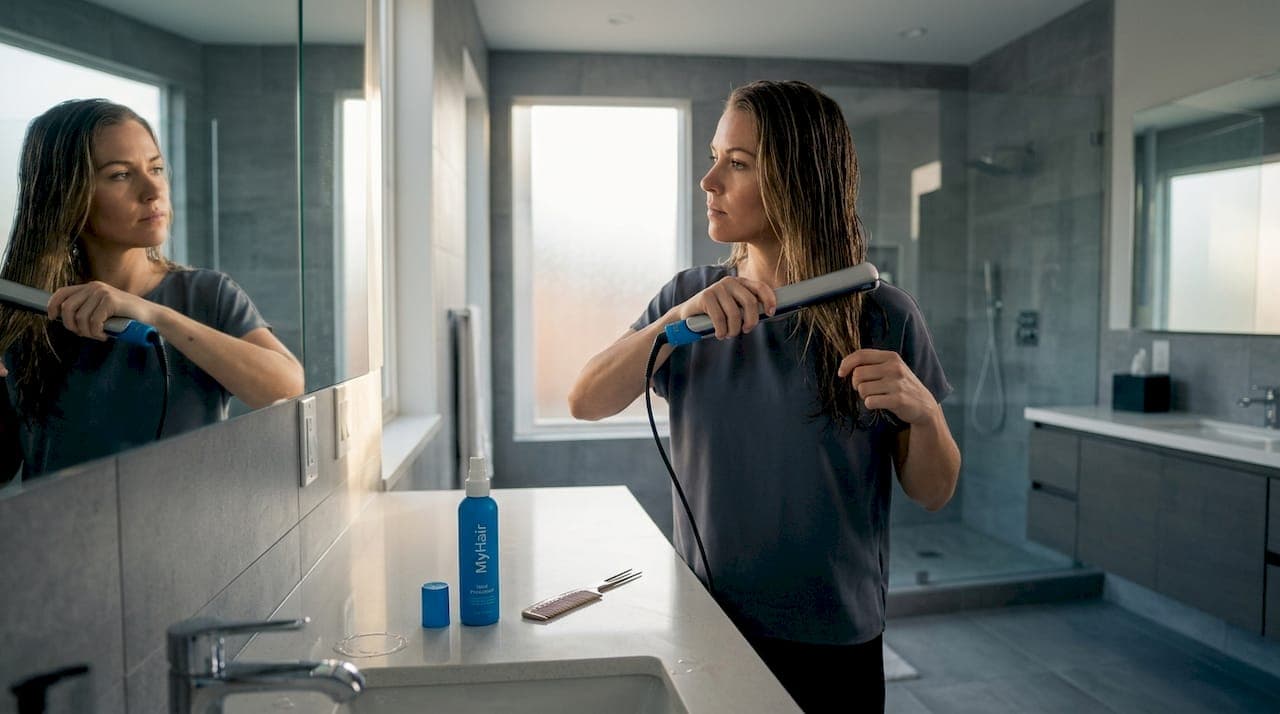
Styling damp hair is even more destructive. When heat tools above 150°C meet water still inside the shaft, the moisture vaporizes and creates microscopic steam cavities in the cortex. This is called bubble hair. You cannot treat it. The affected sections must grow out.
Chemical treatments
Bleach and chemical relaxers work by deliberately breaking disulphide bonds to restructure the hair. Done once with proper spacing, the result can look healthy. But repeated chemical treatments create a feedback loop where each round of damage exposes more fragile bond sites, and the hair weakens at an accelerating rather than linear rate. Bleaching over previously bleached hair compounds the problem faster than most people expect.
Mechanical and environmental damage
| Cause | Mechanism | Result |
|---|---|---|
| Aggressive brushing | Physical force on weakened shaft | Split ends, mid-shaft snapping |
| Tight hairstyles | Constant tension at roots and along shaft | Traction breakage, especially at edges |
| Towel rubbing | Friction on swollen, wet cuticle | Cuticle lifting, increased porosity |
| UV radiation | Oxidative stress breaking surface bonds | Dull, brittle, color-faded hair |
| Chlorine and pollution | Chemical oxidative damage | Weakened disulphide bonds over time |
UV radiation, chlorine, and pollution all contribute to oxidative damage that strips the protective cuticle layer and weakens the bonds underneath. Swimmers who skip protective oils before pool time are stacking chemical damage on top of whatever mechanical stress they put their hair through daily.
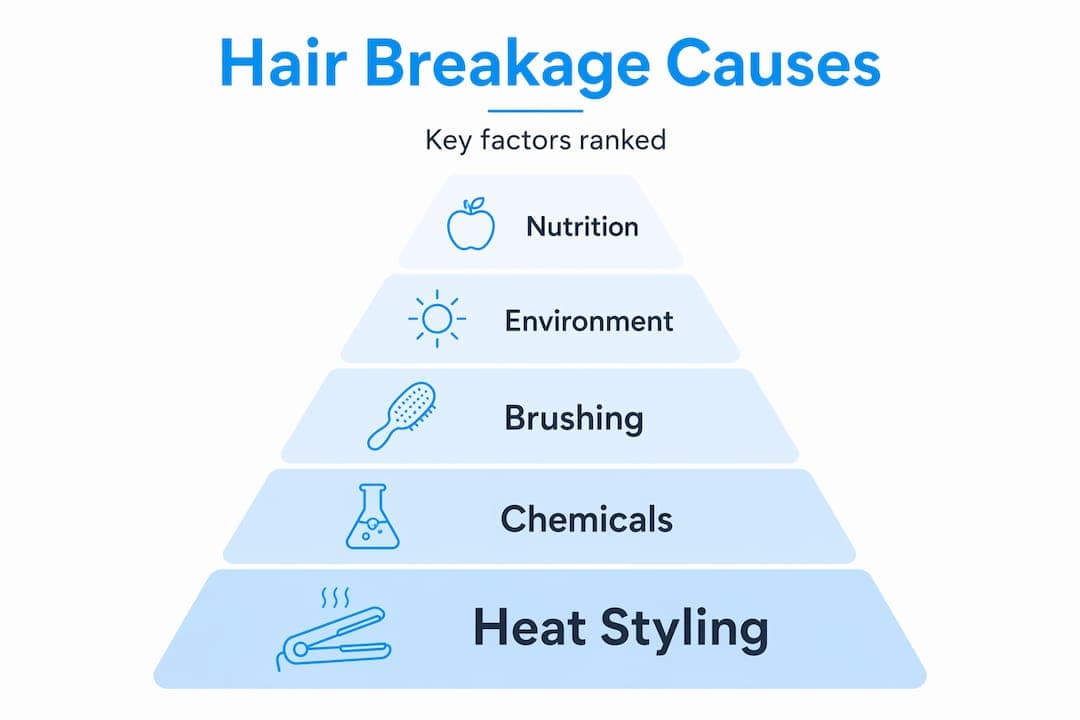
Pro Tip: Always apply heat protectant to completely dry hair before styling. If you are in a rush and your hair is even slightly damp, lower the tool temperature to under 150°C or skip heat entirely that day.
Nutrition, medical conditions, and scalp health
Not all hair breakage causes are external. Some of the most persistent cases trace back to what is happening inside your body.
Vitamin D deficiency is closely linked to dry, brittle hair that breaks easily. Vitamin D plays a role in the hair follicle cycle and in maintaining the moisture-retaining properties of the shaft. Low levels create hair that feels straw-like and snaps with minimal tension. If you have addressed your routine and products but still see consistent breakage, a blood panel checking Vitamin D, ferritin, and thyroid function is worth the conversation with your doctor.
Medical conditions that affect hair fragility include:
- Telogen effluvium: A condition where physical or emotional stress pushes large numbers of follicles into the resting phase simultaneously, accounting for 8 to 17% of hair loss clinic complaints. It often gets misidentified as breakage because the shedding begins 2 to 4 months after the original trigger, well after the stress event has passed.
- Scalp infections: Fungal infections like tinea capitis create brittle, weakened hair that breaks at or near the scalp. The hair does not shed cleanly. It snaps.
- Hypothyroidism: Thyroid imbalance affects keratin production and can make the entire hair shaft thinner and more prone to snapping.
Scalp health is directly connected to breakage severity. Chemical irritation from dyes or harsh cleansers disrupts the scalp barrier and stresses the follicle, which affects the quality of hair produced. Pain, rash, or crusting alongside hair breakage are warning signs that require professional evaluation rather than a new deep conditioner.
You can read more about these connections in Myhair's breakdown of hair breakage medical causes if you suspect an internal factor.
How to prevent and fix hair breakage
Fixing hair breakage is not about adding more products. It is about reducing the cumulative damage load your hair deals with every day. Here is how to approach that systematically.
- Lower your heat tool temperature. Set flat irons and curling wands to 160°C or below for fine or chemically treated hair. Thick, coarse hair can tolerate slightly higher temperatures, but 200°C is never necessary and always causes damage.
- Apply heat protectant every single time. Not most of the time. Every time. A film-forming product with silicones or panthenol reduces direct heat conduction to the shaft.
- Switch from a terrycloth towel to a microfiber towel or cotton T-shirt. Terrycloth roughens the cuticle when wet hair is swollen and vulnerable. Pat dry rather than rub.
- Brush from ends to roots. Starting at the root and dragging through knots multiplies mechanical stress. Work the ends first, then move up in sections.
- Restore moisture before adding more protein. Protein overload increases brittleness rather than repairing it. If your hair feels stiff, snaps easily, and lacks elasticity, it likely needs hydration with ceramides or panthenol, not another protein mask.
- Protect hair before swimming. Apply a leave-in or light oil before entering a chlorinated pool, and rinse your hair immediately after. This limits the oxidative damage that weakens the shaft.
- Audit your diet. Consistent protein intake, iron-rich foods, and adequate Vitamin D support hair that is structurally strong from the inside.
Pro Tip: Do a simple elasticity test monthly. Take a wet strand and stretch it gently. Healthy hair stretches up to 30% before snapping. Hair that breaks immediately with no stretch is screaming for moisture. Hair that stretches and never bounces back has too much protein.
For a more detailed daily plan, Myhair's guide to proven breakage tips walks through routines by hair type.
Myths and overlooked facts about hair breakage
The information around hair breakage is full of well-meaning advice that is either incomplete or outright wrong. These are the ones that matter most.
- "My hair is breaking because I do not condition enough." Conditioning helps, but dry hair is more prevalent among females at 38.9% compared to 32.1% in males, mostly due to cuticle damage impairing moisture retention. Adding conditioner on top of cuticle damage is like painting over a crack in the wall. You need to address what damaged the cuticle.
- "Protein treatments always repair damage." They do not. Excess protein masks make hair brittle. The distinction between needing protein versus needing moisture is critical, and most people default to protein when moisture is actually what is missing.
- "I can reverse heat damage with the right product." No topical product repairs broken disulphide bonds. The only way forward is trimming the damaged sections and protecting new growth from the same exposure.
- "My breakage came on suddenly, so something dramatic must have caused it." Hair damage compounds nonlinearly. A single bleach session or a week of high-heat styling does not cause a specific amount of damage in isolation. Each break point in the hair's molecular structure exposes new vulnerable sites, and the weakening accelerates from there.
Severe hair breakage and thinning that appears alongside scalp symptoms like pain, intense itching, or visible rash is not a product problem. It is a medical problem. See a dermatologist before spending money on treatments.
My take on what actually moves the needle
I have spent a lot of time looking at how people approach hair breakage, and the pattern I keep seeing is this: most people are solving the wrong problem.
When someone comes to me with severe hair breakage and thinning that has not responded to anything, the first thing I ask is whether they have actually confirmed they are dealing with breakage and not shedding. The majority have never done the strand test. They have spent months on breakage remedies for a condition that required a doctor visit.
The other thing I see constantly is the protein trap. Someone reads that protein strengthens hair, starts using protein treatments weekly, and three months later their hair is snapping at the roots. Moisture restoration with ingredients like ceramides and panthenol fixes most breakage cases faster than any protein product. I have seen this play out enough times that I now consider over-conditioning with protein a more common cause of breakage than people realize.
Heat damage is the one I feel most strongly about. People know heat is bad in a vague, general way. They do not know that styling slightly damp hair at moderate temperatures causes permanent bubble hair damage that no treatment can fix. That specific piece of information changes behavior in a way that "heat is damaging" never does.
Real progress on hair breakage comes from accurate identification, targeted fixes, and reducing total damage load. Not more products. Fewer of the wrong ones.
— Cyriac
See exactly what is happening to your hair
Most people are guessing at their hair breakage severity. Myhair changes that with AI-powered analysis that gives you an actual picture of your hair's structural health.
Using your phone camera, Myhair's hair health scanner analyzes your scalp and strands to identify breakage patterns, density changes, and risk factors specific to your hair. You get a clear score and personalized recommendations rather than generic advice. For a full tracking experience, start with app onboarding and monitor how your hair responds to changes in your routine over time. Understanding your hair at this level turns guesswork into progress.
FAQ
What are the most common causes of hair breakage?
Heat styling above safe temperatures, chemical treatments, aggressive brushing, and nutritional deficiencies are the leading hair breakage causes. Environmental factors like UV exposure and chlorine also weaken the hair shaft over time.
How do I know if I have hair breakage or hair loss?
Check the ends of the fallen strands. Breakage hairs have blunt ends with no root bulb, while shed hairs carry a white or translucent bulb at the tip. This single visual check tells you which condition you are dealing with.
Can hair breakage have medical causes?
Yes. Vitamin D deficiency, hypothyroidism, and conditions like telogen effluvium all contribute to hair fragility and are frequently mistaken for cosmetic breakage. If your routine is solid and breakage persists, bloodwork is the logical next step.
Does protein treatment fix hair breakage?
Not always. Protein overload increases brittleness rather than repairing damage, especially when the hair actually needs moisture. Use an elasticity test to determine whether protein or hydration is what your hair is missing.
Is heat damage from styling permanent?
Damage from heat above 180°C breaks disulphide bonds irreversibly. No topical treatment can repair this structural damage. The only real fix is cutting off damaged sections and protecting new growth going forward.