Blog
Learning Materials
Hair growth supplements for men: what works and what doesn't
Updated: May 11, 2026

TL;DR:
- Biotin supplements are ineffective for hair growth in men who are not deficient, despite popular marketing. Understanding the specific cause of hair loss, such as DHT-driven androgenetic alopecia, is crucial before choosing supplements. Evidence supports DHT blockers like saw palmetto and pumpkin seed oil, yet realistic expectations require combining proven treatments with lifestyle changes and objective progress tracking.
Most men dealing with thinning hair reach for a biotin supplement within the first few months. It's marketed everywhere, it's cheap, and the packaging makes bold promises. But biotin is proven ineffective for growing hair in men who aren't already deficient in it, which is the vast majority of supplement users. This guide cuts through the noise and delivers a straight answer on which ingredients actually have research behind them, which are overrated, and how to build a supplement strategy that sets you up for real progress rather than wasted months and money.
Table of Contents
- Understanding the science: What drives hair loss and regrowth in men?
- What the research really says: Debunking popular hair growth supplements
- How do hair growth supplements compare? Ingredient-by-ingredient breakdown
- Setting realistic expectations: How to use supplements for best results
- Our take: Why supplement expectations matter more than the hype
- Ready for a personalized approach? Start with advanced hair analysis
- Frequently asked questions
Key Takeaways
| Point | Details |
|---|---|
| Biotin is ineffective | Despite marketing, biotin doesn't help men's hair growth according to clinical research. |
| Choose proven blends | Supplements with DHT-blockers or antioxidant-rich blends hold more potential value. |
| Patience is required | Any supplement strategy should be followed for several months to gauge real effects. |
| Supplements are adjuncts | Supplements work best when integrated alongside medical treatments and a holistic routine. |
| Personalization boosts success | Tailoring supplement use and routine to your needs delivers better, longer-lasting results. |
Understanding the science: What drives hair loss and regrowth in men?
Before you spend a dollar on any supplement, you need to understand what is actually happening in your scalp. Hair loss in men is not random, and it is not simply about "not getting enough vitamins." The biology is specific, and supplements work only when they target the right biological pathway.
The most common cause of male hair loss is androgenetic alopecia, better known as male pattern baldness. This condition is driven by dihydrotestosterone, or DHT, a hormone derived from testosterone. DHT binds to receptors in hair follicles on the scalp and gradually miniaturizes them, causing hairs to grow thinner and shorter with each cycle until the follicle stops producing visible hair entirely. If your father or grandfather went bald, you already know this is largely a genetic story.
Beyond DHT, other factors can push hair loss forward:
- Chronic stress elevates cortisol, which disrupts the normal hair growth cycle and can trigger a shedding phase called telogen effluvium
- Nutritional deficiencies in iron, zinc, vitamin D, or protein can starve follicles of what they need to stay active
- Scalp inflammation interferes with blood flow and follicle health, particularly in men with seborrheic dermatitis
- Aging naturally slows the rate at which follicles cycle through growth phases
Nutraceutical supplements attempt to target these mechanisms through DHT-pathway modulation, antioxidant defenses, anti-inflammatory compounds, or direct follicle nourishment. The critical point here is that not all hair loss responds to the same approach. A supplement that works for stress-related shedding may do absolutely nothing for someone whose follicles are being miniaturized by DHT.
Key insight: Supplements are not a one-size-fits-all fix. The most important first step is identifying the actual driver of your hair loss. Without that, you are essentially throwing darts in the dark.
For a deeper look at how these patterns develop, exploring understanding male hair loss can help you connect the biology to your own situation before you start any supplement program.
What the research really says: Debunking popular hair growth supplements
Walk into any pharmacy or scroll through Instagram for five minutes, and you will see dozens of supplements promising thicker, fuller hair. The marketing is loud. The evidence, in many cases, is not.
Here is an honest breakdown of what the research actually supports:
| Ingredient | Marketing claim | Clinical evidence |
|---|---|---|
| Biotin | Promotes hair growth and thickness | Ineffective unless deficient |
| Collagen | Rebuilds hair structure | Inconclusive for new growth |
| Nutrafol | Proprietary blend for men | Mixed real-world outcomes |
| Viviscal | Marine protein complex for growth | Mixed, some positive signals |
| Saw palmetto | Blocks DHT naturally | Modest positive signals |
| Pumpkin seed oil | Supports DHT reduction | Early positive data |
| Zinc | Supports follicle function | Effective if deficient only |
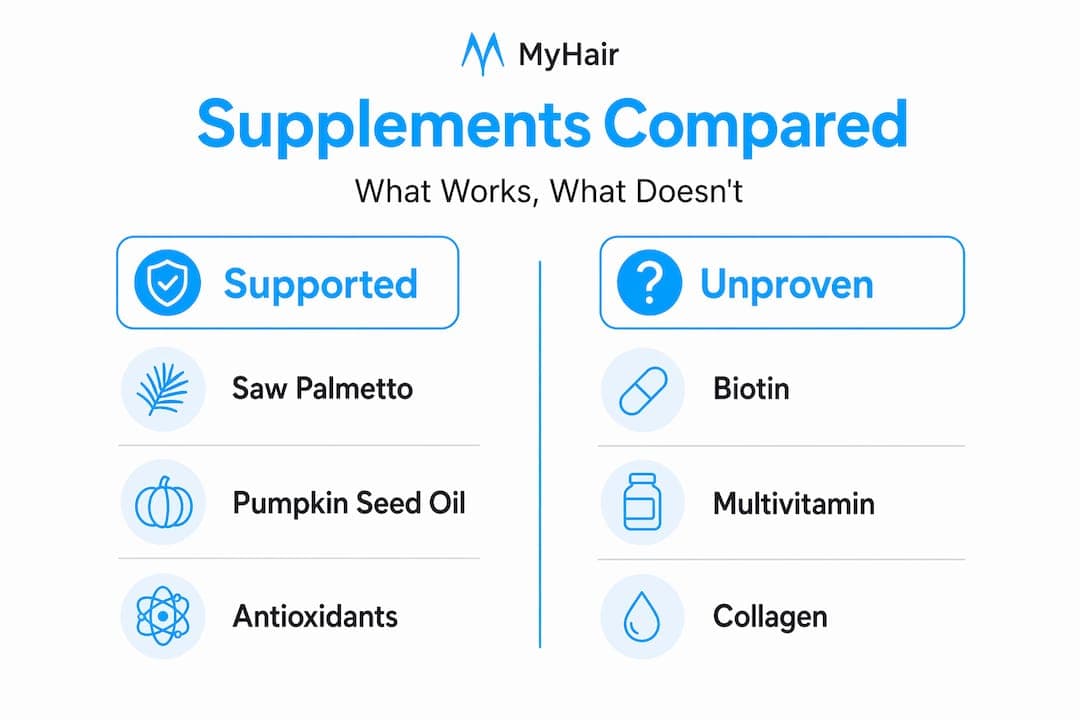
Biotin supplementation is perhaps the biggest gap between marketing and reality. It is the most visible ingredient in hair supplement advertising, yet clinical research consistently shows it fails to grow hair in men who are not biotin deficient. True biotin deficiency is rare in men who eat a varied diet. Collagen supplements tell a similar story. While collagen plays a structural role in skin and hair, the research on whether oral collagen supplementation actually triggers new hair growth is inconclusive at best.

Multi-ingredient blends like Nutrafol and Viviscal are harder to evaluate because their formulas are proprietary. Some men do report improvements, and a handful of company-sponsored studies show modest gains. But independent replication is limited, and results vary widely from person to person.
Stat callout: In a review of commercial hair supplements, the majority of marketed products lacked rigorous, independent clinical trials supporting their specific formulas. Positive results in company-funded studies often do not hold up in broader populations.
Pro Tip: Look for supplements that disclose individual ingredient doses rather than hiding them behind a "proprietary blend." If you cannot see exactly how much of each ingredient is in the product, you cannot evaluate whether the dose is clinically meaningful.
For a fuller look at evidence for hair supplements and which products have the most transparent data, it is worth reviewing before committing to any single brand. You can also find a curated list of top supplements for men to help you compare options more efficiently.
How do hair growth supplements compare? Ingredient-by-ingredient breakdown
Now that you know the landscape, here is a more granular look at the leading ingredient categories and how they perform when placed side by side.
DHT blockers
These are the ingredients with the most mechanistically logical case for fighting androgenetic alopecia. Saw palmetto works by inhibiting 5-alpha reductase, the enzyme that converts testosterone to DHT. Pumpkin seed oil contains phytosterols that may work through a similar pathway. Saw palmetto and pumpkin seed oil show inconsistent but occasionally positive signals in clinical trials, making them the most credible natural options for DHT-driven hair loss.
One small but well-cited study found that men taking pumpkin seed oil experienced a 40% increase in hair count after 24 weeks, compared to 10% in the placebo group. That is promising, but it is also a single study. Saw palmetto results are similarly mixed, with some trials showing modest improvement and others showing minimal effect compared to placebo.
Antioxidant blends
Oxidative stress damages hair follicles over time and may contribute to premature thinning. Antioxidant compounds including vitamin E, vitamin C, and polyphenols are often included in hair supplements to reduce this damage. The logic is sound, but the clinical evidence for antioxidants as standalone hair growth agents remains limited. They are likely most beneficial as part of a broader multi-ingredient product rather than taken in isolation.
Multi-compound products
Blends attempt to address multiple pathways simultaneously. The idea is that DHT blocking plus antioxidant support plus follicle nourishment adds up to better results than any single ingredient alone. This synergistic approach makes theoretical sense, but the research base is still catching up. More long-term, independently funded studies are needed before strong conclusions can be drawn.
Key things to look for when comparing any supplement:
- Transparent ingredient dosing with no hidden blends
- At least one clinical study that is not funded exclusively by the manufacturer
- A clear mechanism of action tied to your type of hair loss
- Absence of ingredients with no established role in hair biology
For more detail on which products have real dosing data, see this guide on supplements for faster growth and a detailed supplements guide that walks through the ingredient categories more thoroughly.
Setting realistic expectations: How to use supplements for best results
This section may be the most important one in the entire article. Not because it tells you which pill to take, but because it tells you how to think about what you are doing.
Here is a structured approach to getting the most from any hair supplement program:
- Get a baseline assessment first. Before you start, document your current hair density, the pattern of thinning, and any symptoms like scalp itching or excess shedding. Photos work. AI-based scanning tools work even better because they give you objective data to compare against later.
- Identify your primary hair loss driver. DHT-driven loss calls for different support than stress-related shedding or a nutritional deficiency. Match your supplement to the cause.
- Start with one or two ingredients. Taking a cocktail of ten different supplements makes it impossible to know what is working. Start simple, run a three to six month trial, and then evaluate.
- Add lifestyle pillars alongside supplements. Sleep, protein intake, scalp blood flow from regular exercise, and stress management all affect the hair growth cycle in measurable ways. No supplement compensates for a diet of 1,200 calories a day or three hours of sleep.
- Consider FDA-approved treatments as your anchor. Minoxidil and finasteride have robust clinical evidence behind them. Supplements should supplement medically proven therapies, not replace them. If you are losing significant hair, supplements alone are unlikely to reverse it.
- Give it time. Realistic timelines matter. Hair grows roughly half an inch per month, and follicles cycling back into active growth takes time. Expect to assess results at the three-month mark minimum, and ideally at six months.
Pro Tip: Set a phone reminder to photograph your scalp from the same angle every four weeks. This removes the subjective bias of checking your hair every morning in the mirror and gives you real trend data to work with.
For practical advice on personalizing your hair care routine and guidance on choosing supplements wisely before you commit to a product, both resources can sharpen your approach considerably.
Our take: Why supplement expectations matter more than the hype
Here is the uncomfortable truth most supplement brands do not want you to hear: the supplement industry is built on hope, and hope is not a clinical trial.
We have seen the frustration firsthand. Men spend six months taking a $70 per month product, see minimal change, and walk away convinced nothing can help them. That is the wrong lesson. Often the problem is not that supplements are useless across the board. The problem is that the wrong supplement was taken for the wrong type of hair loss, with no baseline measurement, no lifestyle support, and an expectation timeline of four weeks instead of six months.
The most defensible approach is to treat supplements as adjuncts with realistic expectations, requiring a months-long trial rather than positioning them as replacements for proven medical therapies. That is the clinical consensus, and it aligns with what we observe when men track their results carefully over time.
What actually works is a combination of three things: choosing ingredients that match your specific biology, integrating supplements into a broader routine that includes proven treatments and lifestyle habits, and measuring your progress with objective data rather than mirror checks.
Skepticism is healthy here. If a supplement promises to regrow hair in 30 days or guarantee results, that is a red flag, not a selling point. Real hair science is incremental. Progress is measured in percentage changes in density over quarters, not dramatic transformations in a month. Men who approach this with patience, good data, and realistic goals tend to get the best outcomes. Those who chase hype tend to cycle through products endlessly without ever knowing why nothing worked.
For a science-grounded overview of science-based solutions that put the clinical picture first, that resource can help you build a more grounded framework for decision-making.
Ready for a personalized approach? Start with advanced hair analysis
Understanding the research is the first step. Applying it to your specific pattern of hair loss is where the real results come from.
MyHair.ai gives you access to AI-powered hair analysis that goes far beyond guesswork. The platform scans your scalp and hair, identifies patterns, tracks changes over time, and generates personalized product and supplement recommendations based on your actual biology, not a generic formula. Instead of wondering whether a supplement is working, you get objective data that shows exactly what is shifting. The easy hair health onboarding process takes minutes, and your personal hair score report gives you a measurable baseline to build from. Real progress starts with real information.
Frequently asked questions
Are hair growth supplements safe for everyday use?
Most hair growth supplements are safe for daily use when you follow package directions, but you should check with your healthcare provider first, especially if you take any prescription medications or have underlying health conditions.
How long does it take to see results from hair growth supplements?
It often takes three months or more of consistent daily use before you notice any meaningful improvement, and six months is a more realistic window for evaluating whether a supplement is working.
Which ingredient works best for male hair regrowth?
No single ingredient is universally best, but DHT-pathway modulators like saw palmetto and pumpkin seed oil, along with antioxidant blends, show the most promise in the current research for men with androgenetic alopecia.
Do I need to take hair supplements forever?
In most cases, yes. Hair regrowth supplements typically need to be continued to maintain any benefits you gain, because stopping use often allows the underlying hair loss process to resume.