Blog
Learning Materials
How AI and Hairfree & Hairgrow improve hair restoration
Updated: May 12, 2026

TL;DR:
- AI and robotics are revolutionizing hair restoration by enabling precise, personalized treatments that outperform traditional methods. They assist in diagnosis, optimize surgical procedures, and support ongoing non-surgical therapies, improving outcomes through data-driven approaches. Combining technology with proven treatments and consistent monitoring ensures the most effective and tailored hair recovery journey.
Hair loss used to feel like a dead end. You'd notice the thinning, try a few products, and eventually accept your fate. But AI and robotics in hair restoration are flipping that script entirely, giving people access to precision tools and personalized plans that were unimaginable even five years ago. This guide breaks down how the Hairfree & Hairgrow approach works, what the science actually supports, and how you can use AI-driven technology today to take real control of your hair recovery.
Table of Contents
- What is Hairfree & Hairgrow? Clinic origins and tech focus
- How AI and robotics are transforming hair restoration
- Evidence-based therapies: The role of medication vs. technology
- Personalizing hair growth: How AI guides your journey
- Why the best hair restoration is high-tech but never one-size-fits-all
- Next steps: Try AI-powered hair analysis
- Frequently asked questions
Key Takeaways
| Point | Details |
|---|---|
| Tech-enabled solutions | AI and robotics are making hair regrowth more personalized and accurate. |
| Combine methods | Best outcomes come from blending advanced technology with proven therapies. |
| Ongoing tracking | AI-powered monitoring helps you adjust hair restoration plans as you progress. |
| No one-size-fits-all | Personalized strategy is essential for successful hair regrowth. |
What is Hairfree & Hairgrow? Clinic origins and tech focus
To understand why this brand stands out, let's look at its core identity and philosophy.
Hairfree & Hairgrow is a clinic network using consistent branding across its platforms, offering a full spectrum of hair restoration and transplant services. What sets it apart from a typical hair clinic is its clear investment in technology as a core part of treatment. Rather than simply offering surgical procedures, the brand positions itself at the intersection of hair science and modern digital tools.
Here is what the brand covers across its network:
- Hair transplant procedures using both surgical and minimally invasive methods
- AI-powered diagnostic tools for scalp and follicle analysis
- Robotic FUE (Follicular Unit Extraction) for precision grafting
- Non-surgical restoration options including topical and laser-assisted therapies
- Educational content explaining technology, procedures, and at-home maintenance
- Progress tracking systems that monitor hair density and coverage over time
This breadth matters because hair loss is not a single condition. Male pattern baldness, female diffuse thinning, and alopecia areata each require different approaches. A clinic network that combines surgical expertise with AI-driven insights can serve a far wider range of patients than one focused solely on transplants.
The brand also serves as a content hub. Its blog and resource library help readers understand what personalized hair loss treatment actually looks like in practice, which reduces confusion for people who are just starting their research. That educational layer builds trust, and trust is often the first barrier people need to clear before committing to a treatment plan.
How AI and robotics are transforming hair restoration
Building on the brand's tech focus, here's how AI and robotics are applied in the clinic and at home.
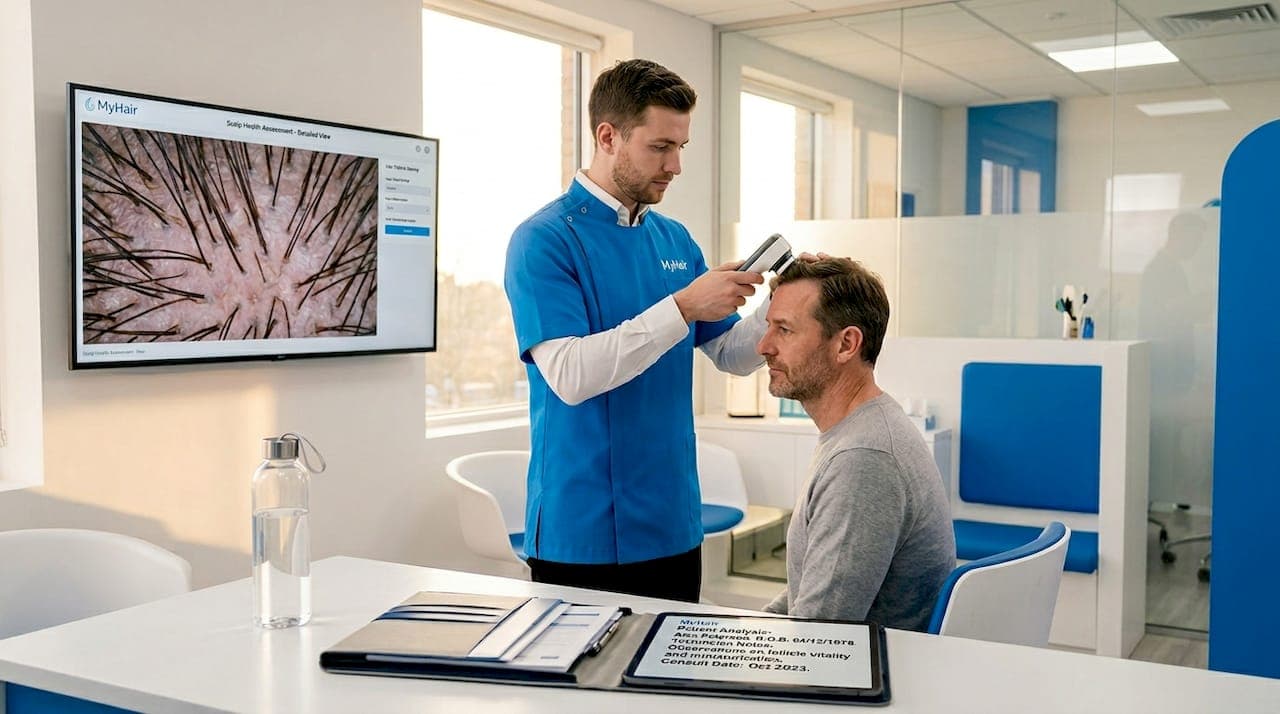
Hairfree & Hairgrow promotes its use of Robotic FUE and AI-powered systems to reduce human error and deliver more consistent outcomes across procedures. This is not just marketing language. The underlying technology changes what is possible in hair restoration in meaningful ways.
Traditional FUE transplants depend heavily on the surgeon's experience and stamina. A tired surgeon on hour five of a procedure will not extract grafts with the same precision as they did in hour one. Robotic systems do not fatigue. They use real-time imaging and AI-guided targeting to identify the best follicles for extraction, map the natural growth angle, and place grafts with a consistency that human hands struggle to match across hundreds of individual follicles.
"The goal isn't to replace the surgeon. It's to amplify what the surgeon can do. AI takes the repetitive, high-precision tasks and executes them at a level of consistency that protects every graft from unnecessary trauma."
Beyond the operating room, AI hair loss reduction tools are now being applied to non-surgical treatment as well. AI algorithms can scan the scalp, measure hair density across zones, and identify early-stage thinning that the naked eye would miss. That early detection changes outcomes because treatments work far better when started before significant follicle damage occurs.
| Feature | Traditional approach | AI/robotic approach |
|---|---|---|
| Graft extraction precision | Surgeon-dependent | AI-guided, consistent |
| Scalp analysis | Visual/manual | Algorithm-based, quantified |
| Error rate | Higher with fatigue | Reduced across full procedure |
| Treatment personalization | General protocol | Data-driven, individual |
| Progress tracking | Subjective assessment | Measured, comparable data |
| Time efficiency | Longer manual procedures | Faster with guided automation |
The data tells a clear story: technology does not just make procedures fancier. It makes them more reliable and more tailored. When you're thinking about personalizing hair growth with AI support, you're tapping into a system that actually learns from your scalp's specific patterns over time.
Pro Tip: If you're evaluating a hair restoration clinic, ask specifically how they use AI in their diagnostic phase, not just during the procedure. Pre-treatment analysis is where personalization actually begins.
Evidence-based therapies: The role of medication vs. technology
While innovation in robotics and AI is appealing, it's important to know how technology works alongside proven treatments.
Technology is a powerful ally, but it is not a cure. The strongest results consistently come when AI-driven tools are layered on top of medically validated therapies, not used as a replacement for them. This distinction matters enormously, and it is something that glossy marketing often glosses over.
One of the most compelling recent developments in medical hair loss treatment is clascoterone 5%. A 2026 study showed clascoterone 5% produced 2.39 times more regrowth in patients who continued treatment for a full year compared to those who stopped at six months. That is a remarkable finding because it challenges the common assumption that a treatment either works quickly or not at all. The reality is that sustained, consistent use compounds over time.
This is precisely where AI personalization becomes invaluable. Many patients stop treatments prematurely because they cannot see visible progress in the short term. AI tracking tools provide objective data on what is actually happening beneath the surface, showing density changes, follicle activity, and coverage improvement that motivates patients to continue. AI-personalization supports medically validated therapies by helping people stay on track and optimize their use of proven treatments.
Here is how the relationship between therapy and technology plays out in practice:
- Establish a medical baseline. Before any AI tool can help, you need a clear diagnosis. Know what type of hair loss you have and what treatments are indicated by a qualified professional.
- Start with evidence-based therapy. Whether it is minoxidil, finasteride, clascoterone, or another validated treatment, begin there. AI tools optimize what is working, not fill a gap where nothing is.
- Layer in AI tracking. Use an AI-powered tool to scan and measure your scalp regularly. This creates objective data that helps you and your provider make better decisions.
- Adjust based on data. If your AI tracking shows density plateauing in a specific zone, that signals a need to reassess. Maybe treatment frequency changes, or a complementary approach is added.
- Continue monitoring. Hair restoration is a long-term process. Monthly or quarterly scans give you AI insights for hair care that turn an otherwise invisible process into something you can actually see and measure.
| Approach | Strength | Limitation |
|---|---|---|
| Medication alone | Clinically proven efficacy | No personalization or tracking |
| AI tools alone | Great personalization | Not a treatment by itself |
| AI plus medication | Maximum effectiveness | Requires consistent commitment |
| Robotic FUE alone | Precision surgical results | Best for those needing transplant |
| Integrated approach | Optimal, adaptive outcomes | Needs coordinated care |
The bottom line: technology amplifies proven treatments. It does not substitute for them. The best clinics and the smartest patients understand this distinction before they commit to any plan.
Personalizing hair growth: How AI guides your journey
So, how do you actually use AI in your hair recovery process? Here's how personalization makes a difference and what to expect.
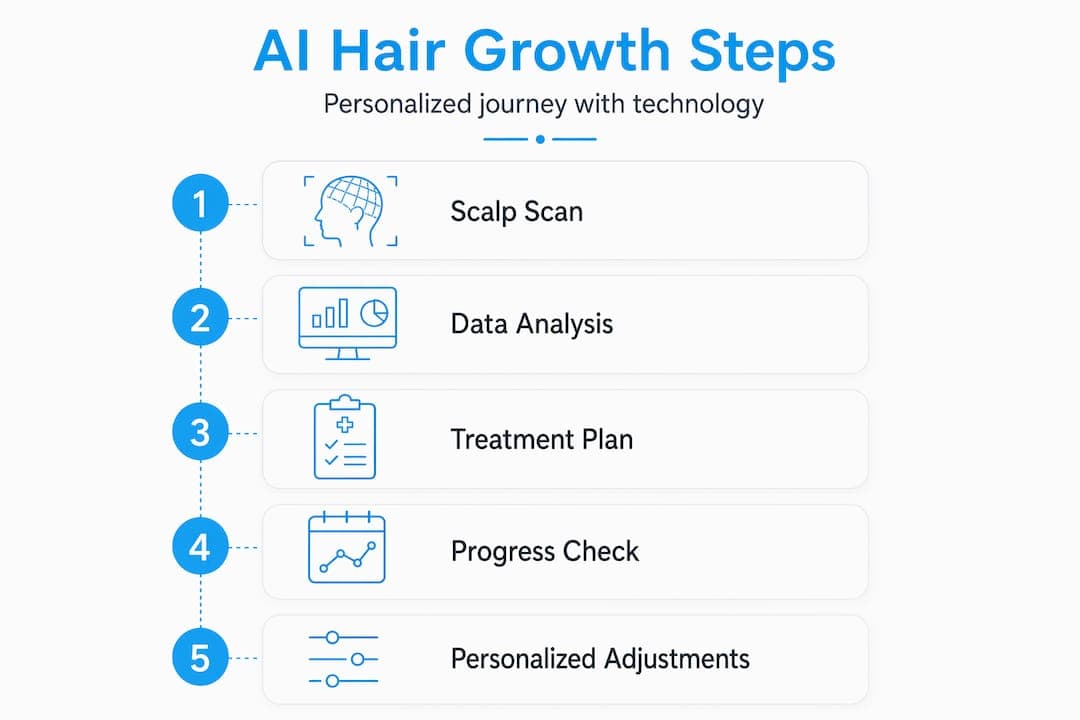
The word "personalized" gets thrown around constantly in wellness, but in the context of AI-driven hair restoration, it has a specific, practical meaning. Hairfree & Hairgrow's AI-powered progress tracking and personalized plan systems generate treatment pathways based on your unique scalp data, not a general protocol designed for the average patient.
Here is what a genuine AI-guided hair recovery journey looks like from start to finish:
- Baseline scan. A high-resolution scalp scan or AI-powered camera analysis captures your current hair density, follicle health, thinning zones, and growth patterns. This is your starting point. Without it, you have no reference for measuring change.
- Pattern recognition. The AI identifies whether your loss follows a classic pattern (like Norwood scale progression) or is more diffuse. This classification directly shapes the treatment recommendation.
- Personalized plan generation. Based on your pattern, history, and goals, the AI generates a plan that specifies which therapies to prioritize, how often to apply them, and what results to expect at each milestone.
- Regular progress check-ins. Every few weeks or months, you re-scan. The AI compares current data to your baseline, flags improvements, and identifies any zones where treatment is underperforming.
- Course corrections. If progress stalls, the system flags it early. This allows your provider, or you, to adjust before weeks of ineffective treatment pile up.
- Long-term data history. Over a year or more, your data history becomes a powerful record. You can see exactly how your scalp responded to every change in therapy, which builds genuine confidence in the process.
Following a structured AI hair growth guide ensures you do not skip the steps that matter most, especially the baseline analysis and the regular check-ins that most people abandon too early.
Pro Tip: Take your first scalp scan before you start any new treatment, not after. Your baseline measurement is far more useful when it reflects your actual starting condition, not a scalp that's already two months into a new routine.
The emotional impact of having real data should not be underestimated. Hair loss is deeply personal, and uncertainty is one of its most frustrating aspects. When you can see a quantified improvement, even a modest one, it changes how you feel about the process. It gives you a reason to continue. Choosing personalized hair treatments based on real scalp data is fundamentally different from guessing.
Why the best hair restoration is high-tech but never one-size-fits-all
With these practical steps covered, here's the truth most don't discuss about balancing tech with real-world results.
There is a real temptation, especially in a field moving as fast as AI, to look for the device or system that does everything. You want to believe that if you just find the right robotic tool or the smartest algorithm, your hair will grow back on schedule. That belief is understandable. It is also a trap.
The patients who get the best long-term results are not those who found the most advanced technology. They are the ones who treated technology as one layer in a broader, evidence-informed strategy. They took their medication consistently. They tracked their progress with honest data. They adjusted when something was not working. And they worked with providers who paid attention to their individual results, not just a general protocol.
What I have seen repeatedly is that blind faith in any single tool, whether it is a robotic procedure, a trending topical, or an app, leads to disappointment. Not because the tools are bad, but because hair restoration requires a feedback loop. You need to know what is happening at your specific scalp, in your specific pattern, over your specific timeline. Personalized AI results only become meaningful when you combine them with a commitment to the underlying medical science.
Technology should make you a smarter patient, not a passive one. The best outcome comes when you understand what your data means, ask your provider the right questions, and stay engaged with your own progress. High-tech hair restoration is genuinely exciting. But it earns that excitement only when it is matched with an equally personalized, evidence-grounded approach.
Next steps: Try AI-powered hair analysis
If you're ready to turn insight into action, here's where to get started with tailored tools and support.
Understanding the science is one thing. Seeing your own scalp data is another. MyHair.ai gives you access to AI-driven hair scanning and a personalized hair score so you can start your restoration journey with real information, not guesswork.
Whether you are considering your first steps or looking to optimize an existing plan, our AI hair analysis tool delivers detailed assessments based on your actual scan. You will see exactly where thinning is occurring, how your follicle density compares over time, and what approaches are likely to work for your pattern. Ready to move forward? Start your analysis today and get the personalized data you need to make confident, informed decisions about your hair health.
Frequently asked questions
Is Hairfree & Hairgrow only for people seeking hair transplants?
No, Hairfree & Hairgrow offers both surgical and non-surgical approaches, including AI-assisted monitoring, scalp analysis, and regrowth support for a wide range of hair loss conditions.
Can AI-powered tools really help regrow my hair?
AI tools personalize and optimize your treatment plan, but they deliver the best results when paired with medically validated therapies rather than replacing them entirely.
What is clascoterone and is it effective for hair regrowth?
Clascoterone 5% is a topical antiandrogen medication, and a 2026 study found it produced 2.39 times more regrowth in patients who continued treatment for a full year compared to those who stopped at six months.
How does Robotic FUE differ from traditional hair transplants?
Robotic FUE uses AI-guided precision tools to extract and implant hair follicles with greater consistency across the full procedure, reducing the variability and fatigue-related errors common in manual techniques.