Blog
Learning Materials
How to use natural growth oil for real hair results
Updated: May 9, 2026

TL;DR:
- Science identifies rosemary and pumpkin seed oils as evidence-backed options for promoting hair growth, unlike popular but unproven oils like castor. A consistent routine involving correct application techniques over 3 to 6 months maximizes results and minimizes irritation. Personalized analysis tools enhance routine effectiveness and help track progress objectively.
If you're staring at a bathroom shelf full of oils with promises of "miraculous regrowth" and still seeing more hair in your brush than on your head, you're not alone. The natural hair oil market is flooded with hype, conflicting advice, and ingredients that sound impressive but deliver almost nothing for actual growth. The good news is that science has quietly separated the winners from the wishful thinking, and a handful of oils have real evidence behind them. This guide cuts through the noise, walks you through choosing the right oil for your specific type of thinning, and gives you a practical routine you can actually stick to.
Table of Contents
- What you need before you start: Choosing the right oil
- How to apply natural growth oil: Step-by-step routine
- Troubleshooting: What to do if you see irritation or no results
- Tracking your progress: How to measure results and stay motivated
- Why most people misuse hair growth oils—and what actually works
- Personalize your journey: Smarter hair growth with MyHair
- Frequently asked questions
Key Takeaways
| Point | Details |
|---|---|
| Evidence-based oils work | Rosemary, peppermint, lavender, and pumpkin seed oils show the best evidence for promoting hair growth. |
| Safety matters most | Always dilute essential oils and patch test to prevent irritation or allergic reactions. |
| Patience is required | Visible hair growth takes consistent oil use for at least 3-6 months—not weeks. |
| Track your progress | Baseline photos and self-assessments help you measure results and adjust routines. |
What you need before you start: Choosing the right oil
Once you know what to expect, it's time to choose the oil that fits your hair needs and goals.
Not all hair oils do the same thing. Some stimulate new follicle activity. Some prevent existing hair from snapping off. And some, despite being wildly popular on social media, have zero human trial data to back up the growth claims. Knowing the difference before you spend money is half the battle.
The evidence-backed oils worth knowing
Rosemary oil is the most studied topical option available. Comparable to 2% minoxidil for androgenetic alopecia after six months of use, with significantly less scalp itching reported, rosemary stands out because it has a plausible mechanism: it inhibits DHT (the hormone that shrinks hair follicles) and improves scalp blood flow. For anyone dealing with pattern thinning at the crown or temples, this is your starting point.
Pumpkin seed oil takes a different path. Taken orally at 400 mg per day, it increased hair count by 40% in men with mild to moderate androgenetic alopecia after 24 weeks, compared to just 10% in the placebo group. This is one of the few natural supplement options with a proper randomized controlled trial behind it.
Peppermint oil is gaining attention for its vasodilatory effect, meaning it widens blood vessels under the skin, which increases circulation to hair follicles. Lavender oil shows anti-inflammatory properties and has been used in combination blends with solid early results. A 2025 randomized controlled trial on Rosmagain, a rosemary and lavender oil combination, showed hair density increases of 32% over 90 days, alongside a 69% improvement in thickness. That kind of data from a peer-reviewed trial is rare in the natural oil space.
The oils that condition but don't regrow
Here's where many people waste months of effort. Castor oil is enormously popular, and it does have genuine benefits. It coats and smooths the hair shaft, reduces breakage, and adds a protective layer that makes hair feel thicker. But no clinical evidence supports castor oil for actually stimulating new growth at the follicle level. If breakage or dryness is your main problem, castor oil is a solid option. If you're trying to regrow thinning areas, it won't move the needle.
Batana oil, coconut oil, and argan oil fall into a similar category: great for hair quality, not proven for growth. Understanding this distinction helps you set realistic expectations and choose the right tool for your actual problem.
Comparison table: Evidence-backed oils at a glance
| Oil | Mechanism | Best use case | Evidence level |
|---|---|---|---|
| Rosemary | DHT inhibition, blood flow | Pattern thinning, androgenetic alopecia | Human RCT |
| Pumpkin seed | DHT inhibition (5-alpha reductase) | Men with pattern hair loss (oral) | Human RCT |
| Peppermint | Vasodilation, circulation | General thinning, slow growth | Animal + early human |
| Lavender | Anti-inflammatory, antioxidant | Inflammation-related thinning | Animal + combo RCT |
| Castor | Moisturizing, breakage prevention | Dry, brittle, breaking hair | Conditioning only |
What to gather before starting
- Your chosen oil (rosemary, pumpkin seed, or a blend)
- A carrier oil like jojoba or coconut for diluting essential oils
- A small applicator bottle with a dropper or nozzle
- A clean towel you don't mind getting oily
- A kitchen timer for your massage session
- A notebook or phone for tracking progress
Pro Tip: Don't expect instant miracles. Most oils with real evidence behind them take 3 to 6 months of consistent use to show visible results. Starting the habit is the hard part. Sticking with it is what actually works.
For a broader overview of what actually works in the natural oil space, plus a closer look at the proven benefits of specific oils, it helps to understand the mechanisms before you commit to a routine.
How to apply natural growth oil: Step-by-step routine
With your oil chosen, you're ready to build a smart routine that maximizes growth and minimizes irritation.

The way you apply oil matters as much as which oil you choose. Simply rubbing a few drops into your hair and hoping for the best is not a routine. A consistent, well-structured approach dramatically improves your odds of seeing real change.
Why technique matters
Oils work through several overlapping mechanisms: improving scalp circulation through massage-induced vasodilation, inhibiting the enzyme 5-alpha reductase that converts testosterone to DHT, delivering anti-inflammatory and antioxidant compounds directly to the follicle, moisturizing the scalp environment, and in some cases prolonging the anagen (active growth) phase of the hair cycle. Getting oil onto your scalp rather than just your hair strands is critical. The follicle is where growth happens.
Step-by-step routine
- Dilute your essential oil. For rosemary or peppermint, mix 2 to 3 drops per teaspoon of carrier oil (jojoba, almond, or light coconut oil). Never apply undiluted essential oils directly to your scalp.
- Patch test first. Apply a small amount to your inner arm and wait 24 hours before your first scalp application. This single step prevents most bad reactions.
- Part your hair into sections. Using a comb, create clear parts so you can access your scalp directly. Target thinning areas first.
- Apply with a dropper or fingertips. Work the oil directly onto the scalp, not just the hair shaft. Use the dropper to deposit small amounts along each part, then spread with your fingertips.
- Massage for 5 to 10 minutes. Use the pads of your fingers in small circular motions across your entire scalp. This is not optional. Massage significantly boosts scalp blood flow, which is part of why topical oils show results in studies.
- Leave the oil on for at least one hour. For deeper conditioning, an overnight application covered with a silk or satin cap works well.
- Rinse thoroughly and shampoo as normal. Use a gentle, sulfate-free shampoo to remove oil residue without stripping the scalp.
Aim for this routine three to four times per week. Daily use is fine for carrier oils, but for essential oil blends, every other day is usually sufficient.
When to consider an oral supplement
If you're a man dealing with pattern hair loss, oral pumpkin seed oil is worth adding alongside your topical routine. The clinical dose used in trials is 400 mg per day, and effects build over several months. For women, topical rosemary remains the most evidence-supported approach.
"Results are gradual and require patience. Expect 3 to 6 months for real, visible changes."
Pro Tip: Pair each oiling session with 5 to 10 minutes of dedicated scalp massage. It's not just a relaxing bonus. It actively moves nutrient-rich blood toward your follicles and meaningfully amplifies what the oil can do on its own.
Build your effective oil routine around consistency, not complexity. A simple, repeatable approach done four days a week beats an elaborate system you abandon after two weeks. Your perfect oil routine is the one you actually stick to.
Troubleshooting: What to do if you see irritation or no results
Even with proper application, you might face bumps in the road. Here's how to handle them safely and smartly.
Normal vs. problematic reactions
A mild tingle or slight warmth after applying peppermint or rosemary oil is completely normal. That sensation is often the vasodilation response doing its job. What's not normal: burning, stinging that persists more than a few minutes, persistent redness, or small raised bumps. If you experience any of those, stop use immediately.
"If burning or severe redness occurs, stop immediately and see a professional."
Common mistakes that kill your results
- Using essential oils undiluted (the most common cause of scalp irritation)
- Skipping the patch test and discovering allergies the hard way
- Rinsing the oil out too quickly, before it has time to penetrate the scalp
- Using an oil without clinical backing for growth (like relying entirely on castor or batana) when you need follicle stimulation
- Applying to the hair shaft only instead of targeting the scalp
What to do when you see no results after 3 to 6 months
First, be honest about your consistency. Missing sessions frequently resets your progress. Second, check whether you're using a evidence-supported oil with human clinical data rather than one that's popular on social media but lacks real trials. Rosemary and pumpkin seed have randomized controlled trials. Most other trendy oils do not.
If you've been consistent for six months with a proven oil and still see no improvement, this is the moment to see a dermatologist. Certain causes of hair loss, such as thyroid issues, alopecia areata, or nutritional deficiencies, need medical evaluation and won't respond to topical oils regardless of how well you apply them.
For a closer look at oils for hair loss tailored to specific causes, or to find the right oil for growth and strength based on your hair type, getting personalized insight makes this process faster and less frustrating.
Pro Tip: Consistency matters far more than quantity. A small, regular application four times a week beats a heavy once-a-month treatment every time. More oil doesn't mean faster results. More time and regularity does.
Tracking your progress: How to measure results and stay motivated
To truly know your efforts are working, it's smart to measure changes objectively and adjust as you go.
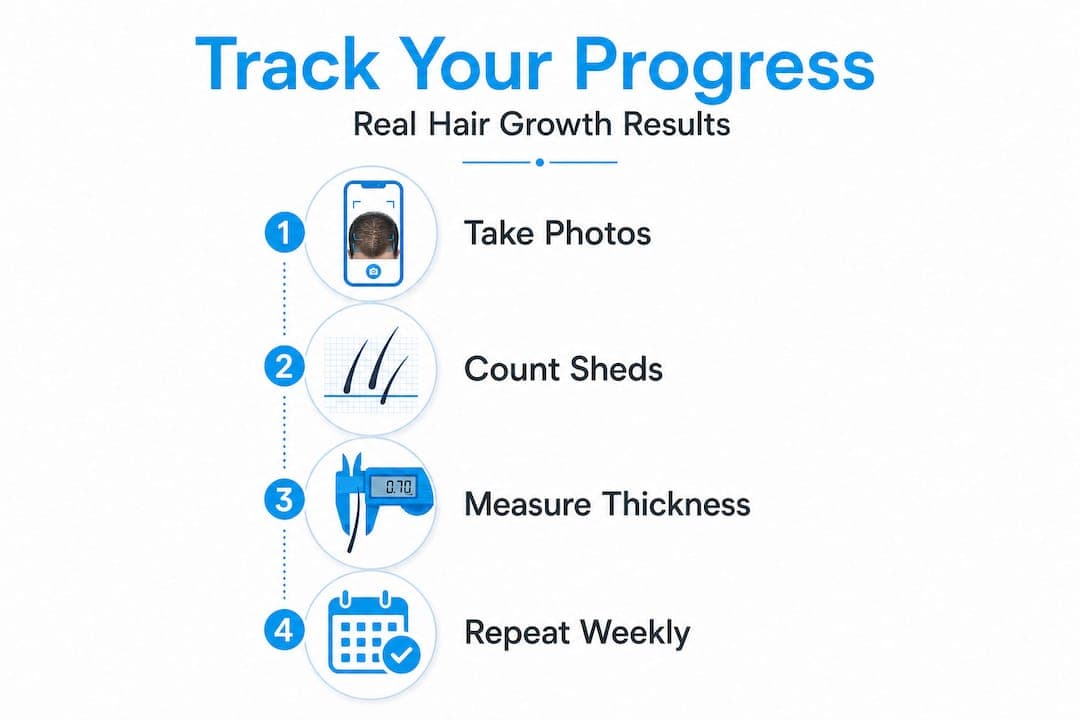
Progress with natural oils is real, but it's slow. The biggest motivation killer is not seeing results that were always there because you had no baseline to compare against. Objective tracking solves this.
What results to realistically expect
Expect less shedding before you see new growth. Hair density and thickness improvements come next, usually around months three to four. By month six, if the oil is working for your type of hair loss, you should see clear improvement in photos taken under the same lighting conditions. A 2025 RCT found that the rosemary-lavender combination Rosmagain increased hair density by 32%, reduced hair fall by over 40%, and improved growth rate by 58% over just 90 days, which gives you a realistic benchmark for what a strong response looks like.
Progress tracking table
| Date | Oil used | Application method | Visible changes noted |
|---|---|---|---|
| Week 1 | Rosemary + jojoba | Scalp drops + massage | Baseline photos taken |
| Week 4 | Rosemary + jojoba | Scalp drops + massage | Slightly less shedding |
| Week 8 | Rosemary + jojoba | Scalp drops + massage | Scalp feels healthier |
| Week 12 | Rosemary + jojoba | Scalp drops + massage | Visible density increase |
Numbered steps to stay motivated
- Take baseline photos on day one under consistent lighting, from the same angles every time.
- Set a calendar reminder every four weeks to take comparison photos and log any changes.
- Track shedding by counting hairs in your brush or shower drain and noting if it decreases.
- Celebrate small milestones, like two months of consistent use, because behavior change is worth recognizing.
- Adjust your routine if you hit three months with zero change. Switch oils, improve your massage technique, or consult a professional.
For curated top oil recommendations or to check the latest oil picks for 2025, having a running shortlist of evidence-backed options saves time when you need to pivot.
Why most people misuse hair growth oils—and what actually works
Now that you know how to track your results, it's worth examining what sets apart successful users from those chasing the next trend.
Here's the uncomfortable truth: most people who try natural hair oils and quit after two months weren't using the wrong oil. They were operating with the wrong mindset. They expected a six-week transformation and got subtle, slow, biological change instead. The oils failed the expectation, not the follicle.
The pattern we see repeatedly is this: someone with genuine early-stage thinning spends three months on a heavily marketed oil with no RCT data behind it, sees nothing, and concludes that natural oils don't work. Then they never try rosemary, which has a legitimate head-to-head trial against minoxidil. That's a real loss.
The second biggest failure point is the patch test. Skipping it feels like saving time, but one bad allergic reaction poisons the entire experience and sometimes permanently puts people off a category of products that could genuinely help them.
The third issue is hype chasing. The natural hair oil market is extremely good at creating viral moments around ingredients with little to no human data. Batana oil is a recent example: a beautiful origin story, striking marketing, and almost nothing from clinical research. Real evidence is boring by comparison. A graph of hair density over 24 weeks doesn't go viral. But that's exactly the kind of data you should be looking for.
Evidence-based oil selection isn't about being rigid. It's about starting with what's most likely to work, staying consistent long enough to see real results, and personalizing based on your own response rather than someone else's before-and-after photos.
Personalize your journey: Smarter hair growth with MyHair
If you want more personalized support, leverage the latest tools to make smarter choices for your hair journey.
Choosing the right oil is one piece of the puzzle. Understanding your specific hair and scalp is another. MyHair's AI hair analysis uses advanced scanning technology to assess your hair health at an individual level, identifying your specific thinning patterns, scalp condition, and growth stage before recommending products or routines.

Rather than guessing which oil suits your type of loss, the platform gives you a starting point grounded in your own data. You can track changes over time, compare progress month to month, and refine your routine based on real measurements. If you're ready to stop experimenting and start seeing results, get started with MyHair today. For those who want to go deeper into the science, the latest hair growth research hub keeps you updated on emerging trials and ingredient developments.
Frequently asked questions
How long does it take to see results with natural hair growth oil?
Most users see noticeable improvement in 3 to 6 months with consistent application, though results depend on oil type and the underlying cause of hair loss.
Is rosemary oil really effective for hair growth?
Yes, studies show rosemary oil matches 2% minoxidil for androgenetic alopecia after six months of topical use, with less scalp irritation reported.
Can I use castor oil alone for hair regrowth?
Castor oil is excellent for moisture and reducing breakage, but no clinical evidence supports it as a standalone regrowth treatment.
Should I use oral or topical oils for hair loss?
Topical rosemary works for most people, while oral pumpkin seed oil at 400 mg per day shows strong clinical results specifically for men with pattern hair loss.
Do I need to see a dermatologist before trying natural oils?
Consult a dermatologist if your hair loss is sudden, patchy, or if you've followed a consistent routine with no improvement after six months.