Blog
Learning Materials
Mature hairline example: is yours stable or receding?
Updated: May 15, 2026
TL;DR:
- A mature hairline is a natural, stable shift that occurs between ages 17 and 30, with minimal recession. It features a symmetrical, gently rounded line with full density behind it and shows no signs of active thinning. Differentiating it from receding hair loss involves photo comparisons over years and understanding specific signs of progression.
Noticing your hairline sit higher than it did at 20 is unsettling, but it does not always mean trouble. A mature hairline is a natural, stable shift that most men experience gradually between their late teens and early thirties, and then it simply stops. The problem is that this normal change looks almost identical to the early stages of a receding hairline, which is why so many adults spiral into unnecessary anxiety or, worse, skip getting checked when they actually should. This article cuts through that confusion with real mature hairline examples, photo comparison methods, and clear criteria for knowing when to monitor and when to act.
Table of Contents
- Understanding a mature hairline: definition and typical patterns
- How to distinguish a mature hairline from receding hair loss
- Practical examples: mature hairline photos and typical scenarios
- When and why to seek treatment: managing mature hairlines and early receding
- Designing a mature hairline with hair restoration: age-appropriate strategies
- Why embracing your mature hairline can be the best choice
- Explore personalized hair analysis and care with MyHair
- Frequently asked questions
Understanding a mature hairline: definition and typical patterns
A mature hairline shifts about 1 to 1.5 cm backward from the adolescent hairline, typically between ages 17 and 30, and then holds its position for the rest of a man's life. That is the clinical definition, and it matters because the distance is small. We are talking about the width of your fingernail, not a dramatic retreat across the scalp.
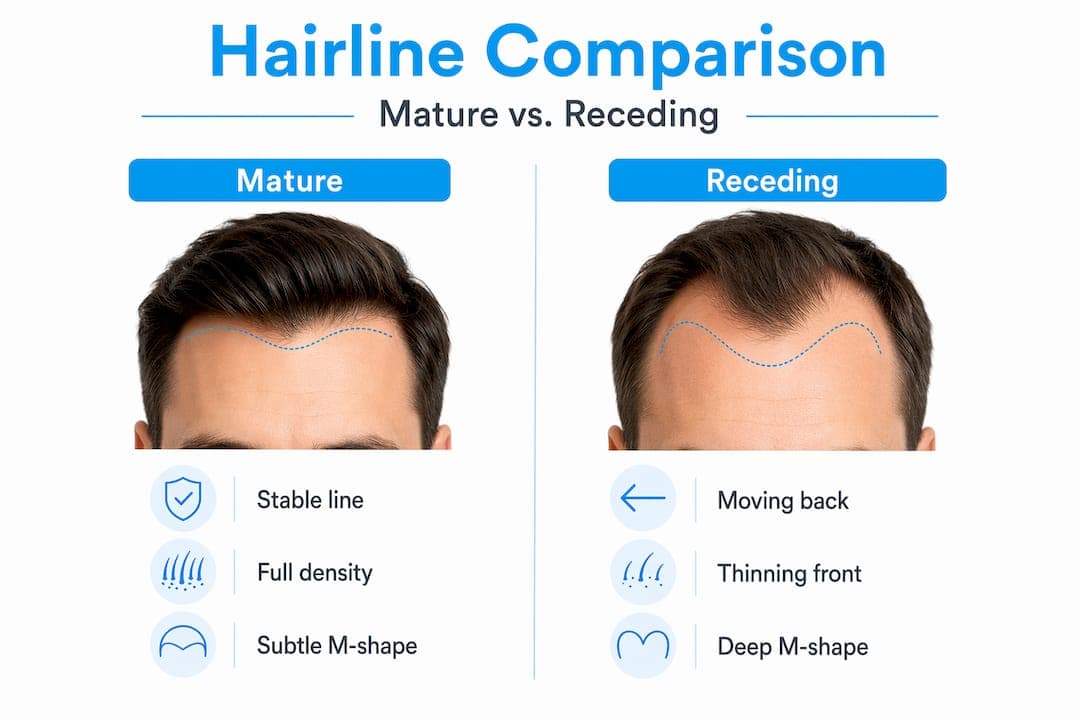
What makes a mature hairline recognizable is its combination of features. The line moves up slightly at the temples, creating a gentle rounding or a very mild curve, but it stays even and symmetric. Hair density directly behind the line remains full. There is no scalp showing through, no patchy zones, and no dramatic spike in daily shedding. These are the hallmarks of normal hairline characteristics in adult men.
Key mature hairline characteristics to recognize at a glance:
- The hairline sits roughly 1 to 1.5 cm above where it was in your late teens
- Temples show mild, even rounding without sharp angles or deep recession
- Hair density behind the line is full and consistent with the rest of your scalp
- No visible thinning, patchiness, or increased scalp exposure in the crown area
- Daily shedding stays within normal range (roughly 50 to 100 hairs per day)
- The shape appears symmetric, meaning both sides recede equally
One nuance worth knowing: maturation does not happen overnight. It is gradual and often goes unnoticed until someone sees an old photo and thinks something has changed dramatically. In reality, that change occurred over years and then stopped. That stop is everything.
How to distinguish a mature hairline from receding hair loss
This is where most people get stuck, and understandably so. The early stages of a receding hairline and a maturing one can look nearly identical in a mirror on any given morning. The difference lies in progression over time, not appearance at a single moment.
The most reliable method is the photo comparison test. If your hairline looks identical to photos from 2 to 3 years ago, it is almost certainly mature and stable. If it has visibly moved back, you are likely dealing with active recession. Most people do not take standardized photos, which is exactly why tracking hairline changes accurately is so difficult without the right tools.
Here is how to run your own photo comparison effectively:
- Pull out photos from 2 to 3 years ago, ideally taken in similar lighting and from the same angle (slightly above eye level, facing forward).
- Take a new photo today under the same conditions, in natural light if possible.
- Compare the hairline position relative to fixed facial landmarks like the tops of your ears or the outer corners of your eyebrows.
- Look specifically at the temples. Symmetric, minimal recession suggests maturity. Deepening angles or an emerging M shape with thin hair on the sides points toward active recession.
- Check crown photos too. A mature hairline leaves the crown alone. A receding hairline often involves crown thinning over time.
- Repeat this process annually to build a reliable picture of change or stability.
Beyond photos, receding hairline solutions become relevant when you notice these specific warning signs. A progressing receding hairline typically involves temple recession beyond 1.5 cm, visible crown thinning, noticeably increased daily shedding, and a family history of male pattern baldness. Any one of these on its own warrants attention. Multiple signs together make professional evaluation a priority.
| Feature | Mature hairline | Receding hairline |
|---|---|---|
| Rate of change | Stable for 2+ years | Continues progressing |
| Temple shape | Gently rounded, even | Sharp M shape, deepening |
| Hair density behind line | Full and thick | Thinning or patchy |
| Crown involvement | None | Often thins over time |
| Daily shedding | Normal range | Noticeably increased |
| Family history relevance | Low factor | High factor |
Pro Tip: Take a standardized "hairline check" photo on your birthday each year, same angle, same lighting. One annual comparison tells you far more than daily mirror checks, which are too inconsistent to reveal gradual change.
Practical examples: mature hairline photos and typical scenarios
Looking at mature hairline photo comparisons helps more than any written description. Here is what you actually see across common scenarios in adults aged 30 and older.
Scenario one: the subtle M shape with full density. This is one of the most misread mature hairline examples. The hairline dips very slightly at the center and shows minor temple rounding, creating what looks like a faint M or V. But zoom in on the hair behind that line and it is completely dense. No gaps. No scalp visible. No thinning at the temples beyond the initial recession point. This is textbook maturation, not loss.

Scenario two: even temple rounding with a stable peak. Both temples have receded by roughly the same small amount, and the hairline forms a gentle arc. The forehead looks slightly larger than it did at 19, but annual photos confirm nothing has changed in three years. Hair texture and thickness remain consistent. This is another classic example of a mature hairline that requires no intervention.
Scenario three: the celebrity comparison. Many well-known men in their 30s and 40s display visible mature hairlines that have simply been accepted as part of their adult look. The distinction between their hairlines and a receding one is density. A mature hairline often forms a subtle, natural M or V shape while maintaining thick, healthy hair directly behind the line. That density is the giveaway.
Additional patterns worth recognizing:
- A hairline can appear higher at 32 than at 22 and still be completely stable
- Even slight asymmetry between temples is normal and does not indicate active loss
- Hairline texture (fine vs. coarse hair at the front) can look different from the mid-scalp without signaling a problem
- Male hairline examples and patterns vary significantly by ethnicity and genetics, which affects what "normal" looks like for different men
Pro Tip: If you are unsure whether your hairline is maturing or receding, look at the hair behind the front line, not just the line itself. Thinning scalp coverage behind the hairline is the red flag. A clean, dense zone behind a slightly higher line is reassurance.
When and why to seek treatment: managing mature hairlines and early receding
A stable mature hairline needs no treatment. That bears repeating because the hair loss industry creates significant pressure around hairline changes, and not all of it is warranted. Annual photo monitoring is genuinely sufficient for most men in their 30s who fall into the mature hairline category.
When to start paying closer attention:
- Recession continues noticeably after age 30
- Temple angles deepen or the M shape becomes more pronounced year over year
- Crown thinning begins alongside hairline changes
- Daily shedding increases substantially and persists for several months
- Multiple close male relatives experienced significant hair loss before 40
Early evaluation helps confirm whether a hairline change is stable maturation or ongoing loss, which directly guides treatment timing and effectiveness. Catching active recession early matters because the treatments available (including proven medical options and restoration procedures) work better when hair follicles are still partially active rather than fully miniaturized.
Habits that support hair health regardless of your current hairline status:
- Eat adequate protein. Hair is primarily keratin, and low protein intake accelerates shedding.
- Manage stress actively. Elevated cortisol disrupts the hair growth cycle.
- Avoid tight hairstyles that create chronic tension at the hairline.
- Use gentle, sulfate-free shampoos to minimize scalp irritation.
- Consider annual scalp assessments through early receding hairline treatments if you notice early warning signs.
Designing a mature hairline with hair restoration: age-appropriate strategies
If you are considering hair restoration, how the surgeon designs your hairline matters as much as the procedure itself. A common mistake is designing a hairline for a 20-year-old on a 40-year-old face, which creates an unnatural appearance that becomes progressively harder to manage as aging continues.
Surgeons who specialize in age-appropriate hairline design place the restored line about 1 to 2 cm higher than a juvenile hairline, with mild temple recession built in intentionally. This accounts for how the face changes with age and how the existing donor hair supply needs to serve potential future loss, not just today's deficit.
Key principles guiding mature hairline design in restoration:
- Placement uses bony landmarks (the frontotemporal suture) for consistent, natural positioning
- Temple angles are deliberately preserved rather than straightened
- Graft density is highest at the very front, tapering naturally behind it
- Future hair loss patterns are mapped out so grafts are not wasted on areas likely to stay dense
- Soft irregularities are intentionally built into the hairline edge to avoid the "too perfect" look
| Hairline design type | Appearance in 10+ years | Risk of unnatural look |
|---|---|---|
| Juvenile, low placement | Often mismatches aging face | High |
| Mature, age-appropriate | Ages naturally with the patient | Low |
| Overcorrected, too high | May look recessed, unbalanced | Moderate |
Pro Tip: Before any restoration consultation, use AI hair analysis to document your current hairline precisely. Having objective baseline data gives your surgeon better information and gives you a clearer picture of what you are actually working with.
Why embracing your mature hairline can be the best choice
Here is something the hair restoration industry rarely leads with: for the majority of men in their 30s who are anxious about their hairline, nothing is wrong. The hairline has matured, stabilized, and is doing exactly what adult hairlines do.
The pressure to act comes from two directions. One is comparison to younger versions of yourself, which is a genuinely unreliable standard because no one keeps a 20-year-old hairline forever. The other is the cultural narrative that a higher hairline signals decline, which simply is not true medically or aesthetically.
Chasing a juvenile hairline on an adult face consistently produces results that age poorly. A sharply low, perfectly straight hairline at 45 looks unnatural in a way that is difficult to pinpoint but instantly noticeable. Conservative, age-appropriate restoration, when it is actually needed, produces results that grow gracefully and never require expensive revisions.
The men who make the best decisions about their hairlines share one trait: they understand the difference between a natural, stable change and a progressing one before deciding what to do. That understanding removes panic from the equation and leaves room for rational choices. Personalized hair loss solutions work best when they are matched to what is actually happening on your scalp, not to your anxiety about it.
Monitoring annually, understanding what mature hairline examples actually look like, and consulting a professional only when progression is confirmed is a far better strategy than early, aggressive intervention on a hairline that was never going anywhere.
Explore personalized hair analysis and care with MyHair
Managing hairline uncertainty becomes significantly easier when you have objective data instead of guesswork. MyHair.ai offers AI-powered hair analysis that tracks your hairline changes over time using precise scan comparisons, so you can tell whether your hairline is stable or shifting without relying on memory or inconsistent mirror checks.

Whether you want to confirm a mature hairline, detect early recession, or build a personalized care plan, MyHair connects you with the tools and expert support to make informed decisions. Explore professional hair care solutions for clinical guidance, or start with the hair analysis app for an immediate, easy baseline assessment of where your hairline stands right now.
Frequently asked questions
What is a mature hairline example?
A mature hairline example shows a natural, stable shift of about 1 to 1.5 cm backward from the teenage hairline, with full hair density behind the line and no further progression for at least 2 to 3 years.
How can I tell if my hairline is receding or just maturing?
Compare standardized photos from 2 to 3 years ago with current ones. If the hairline looks identical over time, it is likely mature; if it has visibly moved back with thinning at the temples, it is probably an active receding hairline.
At what age does a mature hairline typically stabilize?
A mature hairline typically stabilizes between ages 25 and 30 and then remains consistent for life; continued recession after 30 is a reliable indicator of male pattern hair loss rather than normal maturation.
Should I treat a mature hairline?
Treatment is not needed for a stable mature hairline since it is a normal adult development. Annual photo monitoring is the smartest step, and a professional consultation is only warranted if progression becomes visible after 30.
How do hair restoration surgeons approach mature hairlines?
Surgeons design the new hairline placement about 1 to 2 cm above the juvenile position, with intentional temple recession and soft irregularities built in, ensuring the result ages naturally rather than looking unnatural as the face continues to change.