Blog
Learning Materials
Professional hair loss treatment: evidence-based options that work
Updated: April 18, 2026

TL;DR:
- Accurate diagnosis and personalized testing are essential for effective hair loss treatment.
- Treatments like minoxidil, finasteride, JAK inhibitors, and transplants vary based on the condition.
- Most therapies require 3 to 6 months to show visible results, emphasizing patience and monitoring.
Most people spend months trying shampoos, supplements, and online remedies before realizing none of them actually work. That frustration is common, and it's not your fault. The hair loss industry is packed with products that promise results but lack real clinical backing. What actually moves the needle is a professional, evidence-based approach that starts with an accurate diagnosis and ends with a treatment matched to your specific biology. This guide walks you through the top proven options, explains why personalization matters more than any single product, and shows you how to stop guessing and start seeing real progress.
Table of Contents
- Why professional diagnosis matters for hair loss
- Top evidence-based treatments for hair loss
- Personalization: Matching treatment to your hair loss type
- Risks, expert tips, and setting expectations
- Our take: Why personalization beats one-size-fits-all in hair loss treatment
- Next steps: Get a personalized hair loss treatment plan
- Frequently asked questions
Key Takeaways
| Point | Details |
|---|---|
| Diagnosis is essential | An accurate hair loss diagnosis guides the best professional treatment and avoids frustration. |
| Evidence supports tailored care | Leading treatments like minoxidil, finasteride, and JAK inhibitors require matching to your specific type for the best results. |
| Personalization drives success | Testing and expert input turn trial-and-error into a customized plan, improving outcomes and minimizing risks. |
| Expect gradual results | Effective solutions need months to show results—patience and realistic expectations are key. |
Why professional diagnosis matters for hair loss
Before you spend a dollar on treatment, you need to know exactly what type of hair loss you have. This sounds obvious, but it's one of the most skipped steps. Three people can walk into a clinic with thinning hair and all three can have completely different conditions requiring completely different treatments.
The most common types include:
- Androgenetic alopecia (AGA): Genetically driven hair loss tied to hormone sensitivity, affecting both men and women.
- Alopecia areata (AA): An autoimmune condition where the body attacks hair follicles, causing patchy or total hair loss.
- Diffuse patterned alopecia (DPA) and diffuse unpatterned alopecia (DUPA): These affect the entire scalp rather than specific zones and have major implications for surgical options.
Misdiagnosis is costly. If you're treating what you think is AGA but actually have AA, you could spend years on minoxidil without meaningful results. Worse, you might pursue a hair transplant only to find out your pattern makes you a poor candidate.
Proper diagnosis changes everything because certain effective treatments only work with specific conditions. JAK inhibitors, for example, are designed for AA, not AGA. Anti-androgens may help women with hormonal hair loss but carry real risks if used incorrectly. When you start with an accurate picture of what's happening on your scalp, every decision downstream gets sharper.
"The most overlooked factor in hair loss care isn't which product to use. It's whether the right diagnosis was made in the first place."
One particularly valuable example is sulfotransferase enzyme testing. Personalized treatment essential: testing this enzyme can predict whether you'll actually respond to minoxidil, since around 60% of men lack sufficient activity to benefit from it. That kind of data-driven, personalized hair loss care model is what separates a guess from a plan.
Pro Tip: Before starting any treatment, ask your dermatologist or hair specialist about diagnostic testing, including scalp biopsy, blood panels, and enzyme activity screens. These results can save you months of trial and error.
Top evidence-based treatments for hair loss
Once you have a diagnosis, you can match treatment to condition. Here's how the leading options compare:
| Treatment | How it works | Best for | Key limitation |
|---|---|---|---|
| Topical minoxidil 5% | Vasodilation, Wnt pathway activation | AGA in men and women | ~60% non-responder rate |
| Topical finasteride | Blocks DHT at the scalp | Male AGA | Not recommended for women |
| Oral minoxidil | Systemic vasodilation | AGA, various patterns | Systemic side effects |
| JAK inhibitors | Immune modulation | Severe alopecia areata | Monitoring required |
| Hair transplant (FUE/FUT) | Follicle relocation | Stable AGA, DPA | Not suitable for DUPA |
Minoxidil remains the most widely used starting point. It works through vasodilation, anti-inflammatory effects, and activation of the Wnt/β-catenin pathway, which extends the hair's active growth phase. 5% twice daily increases hair count and density compared to placebo, but roughly 60% of men are non-responders due to low sulfotransferase activity. That's a significant number, and it's why testing matters before committing.
Topical finasteride works by blocking 5-alpha-reductase, the enzyme that converts testosterone to DHT (dihydrotestosterone, the hormone that shrinks hair follicles). Scalp DHT reduction through the topical form delivers results with fewer systemic side effects than the oral version, making it a preferred option for men who are concerned about sexual side effects.
JAK inhibitors are a newer class of treatment that specifically target the immune response in AA. Ritlecitinib (sold as LITFULO) is FDA-approved and achieves SALT score of 20 or less in 23% of patients at 24 weeks versus just 1.6% on placebo. Long-term data shows 73.5% reaching that benchmark at 24 months. These are meaningful numbers for a condition that has historically been very difficult to treat.
For a deeper look at what's available now, the latest advanced hair loss solutions continue to evolve, and staying current helps you have smarter conversations with your provider. Understanding which category of treatment fits your condition is also part of building personalized treatment approaches that actually hold up over time.
Personalization: Matching treatment to your hair loss type
Generic treatment plans tend to produce generic results. The reason most people plateau or give up on hair loss treatment isn't because nothing works. It's because they were using the wrong thing for their specific biology.
Here's how a personalized treatment process actually works in practice:
- Diagnose the condition accurately. Scalp biopsy, trichoscopy (magnified scalp analysis), blood work, and enzyme testing narrow down exactly what you're dealing with.
- Assess individual and medical factors. Your age, sex, hormonal profile, family history, and any existing health conditions all shape which options are safe and appropriate.
- Select and monitor the treatment. Start with the best-matched intervention, track response over 3 to 6 months, and adjust based on results.
Personalization also protects you from harm. Women need caution with anti-androgens, for example, especially those who are pregnant or planning to become pregnant. Transplant candidacy is another area where individual assessment is critical. DPA patients may be good surgical candidates, but DUPA patients are not, since the diffuse nature of their loss means donor hair is also unstable.
The table below shows how different patient profiles lead to different recommended approaches:
| Patient profile | Primary recommendation | Notes |
|---|---|---|
| Male AGA, responds to minoxidil | Topical minoxidil + finasteride | Confirm via enzyme test |
| Male AGA, minoxidil non-responder | Oral minoxidil or finasteride | Alternative pathway |
| Severe AA | JAK inhibitor (ritlecitinib) | Monitor closely |
| Female AGA, hormonal component | Topical minoxidil, specialist review | Caution with anti-androgens |
| Stable AGA, good donor area | Hair transplant | Rule out DUPA first |
Pro Tip: If you've tried minoxidil for 6 months without results, ask specifically about sulfotransferase testing before switching to something more expensive. You may simply be a non-responder, and there are better options for you.
AI-powered tools are also changing how individualized care gets delivered. By analyzing scalp scan data and tracking changes over time, these tools give clinicians and patients a much clearer picture of what's working and what isn't, faster than traditional methods alone.
Risks, expert tips, and setting expectations
Even the most effective treatments come with limitations. Knowing the honest picture going in helps you stay committed when progress feels slow and helps you recognize when something isn't right.
Here's what you need to know about the most common treatments:
- Minoxidil: 5% twice daily is ranked highest for density change in network meta-analysis, but it requires consistent use. Stopping it leads to shedding within months.
- Hair transplants: 90 to 98% graft survival is achievable in experienced hands, with low complication rates overall. Edema (swelling) affects 40 to 50% of patients post-procedure, infection occurs in under 1%, and significant pain is reported in about 6% of cases.
- Cicatricial alopecia (scarring hair loss): Transplant success rates are lower, ranging from 41 to 87% at 1 to 5 years, and the condition must be fully stable before any surgery is considered.
- DUPA patients: No surgery is indicated because donor hair is also at risk of thinning, making transplants a poor long-term investment.
- JAK inhibitors: These require ongoing monitoring for serious risks including infections and major adverse cardiovascular events (MACE).
"Expecting results in 4 weeks is setting yourself up for disappointment. The follicle growth cycle moves on its own timeline, not yours."
Timelines are one of the hardest things for people to accept. Most treatments need 3 to 6 months before you see visible improvement. Some, like hair transplants, take a full year to show final results. Impatience leads to people quitting treatments that were actually starting to work.

Pro Tip: Take monthly photos under consistent lighting to track subtle changes. Progress in hair regrowth is often invisible day to day but obvious when compared across months.
For a broader look at what the evidence supports, recommended treatment strategies pull together clinical guidance that helps you and your provider make better decisions. Keeping up with hair loss innovations also ensures you're not missing newer options that may be better suited to your pattern.
Our take: Why personalization beats one-size-fits-all in hair loss treatment
Here's something most people in the industry won't say out loud: the reason so many treatments fail isn't the science. The science is solid. The reason is that treatments are applied generically to people who need individualized solutions.
We've seen this pattern repeat constantly. Someone starts a treatment that works well for 40% of people, gets no result, and concludes that "nothing works." But that experience was never evidence that the treatment failed. It was evidence that it wasn't the right match.
The shift happening now, driven by AI diagnostics and advanced testing, is moving the field from population-level guessing to individual-level precision. Clinicians who use these tools aren't just prescribing based on pattern recognition. They're working from real scalp data, enzyme activity results, and progression tracking.
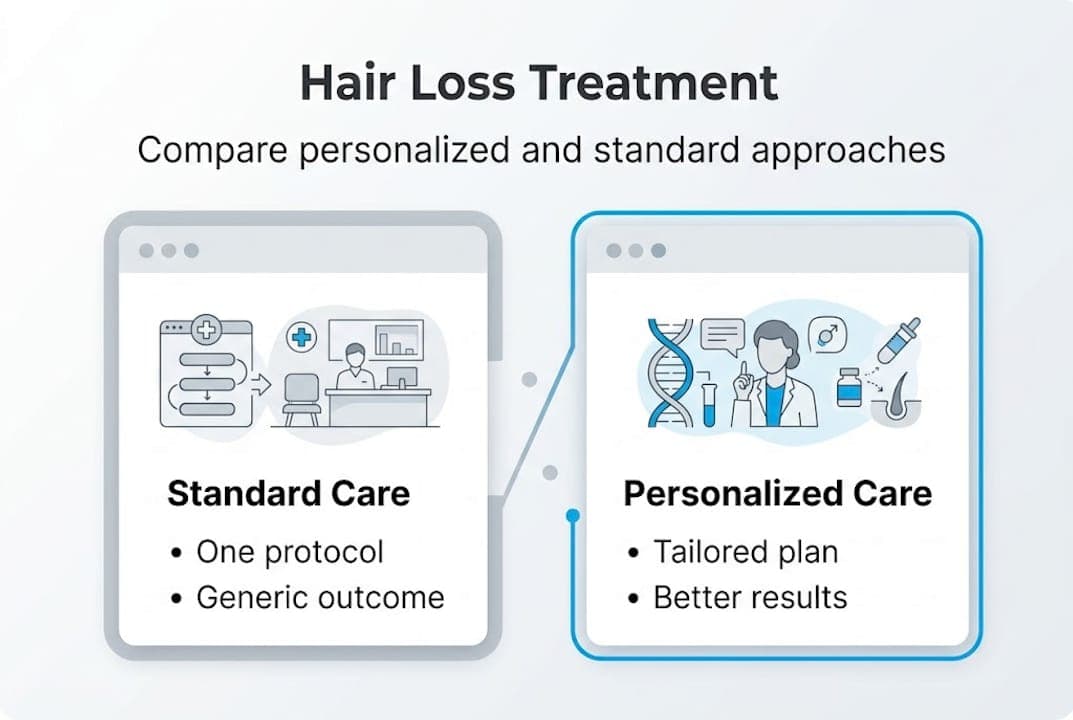
The personalized approach to hair care isn't a premium add-on. It's the baseline that actually produces lasting results. Generic solutions will always produce generic outcomes. That's not pessimism. It's just how biology works.
Next steps: Get a personalized hair loss treatment plan
If you're ready to move past guesswork, here's how you can take control with the latest tools.
Understanding exactly what's happening on your scalp is the first real step toward a treatment plan that works. MyHair.ai uses AI-powered analysis to assess your scalp health, track changes over time, and match your profile to evidence-backed recommendations tailored to your specific pattern.
You can start with the AI hair analysis tool to get an immediate picture of your hair health, or check your personalized hair score to understand where you stand. Ready to go further? Start your hair treatment journey with a science-backed plan built around your biology, not someone else's.
Frequently asked questions
What is the most effective professional treatment for hair loss?
Minoxidil 5% topical has the highest ranking for density in network meta-analysis, but the right choice depends on your diagnosis. Finasteride, JAK inhibitors, or surgical options may be more appropriate depending on your specific condition.
How long before I see results from hair loss treatment?
Most treatments require 3 to 6 months before visible hair growth appears. Hair transplants can take up to 12 months to show their final outcome.
Who is not a candidate for hair transplant surgery?
People with DUPA or active disease are not suitable candidates for hair transplant surgery because donor hair is unstable or the scalp environment is not ready for grafting.
Can women use finasteride for hair loss?
Women should approach finasteride with caution, as anti-androgen use in women carries specific risks, especially for those who are or may become pregnant. A specialist's evaluation is essential before starting.
Are there risks with JAK inhibitor treatments?
Yes. JAK inhibitors are effective for severe alopecia areata but require regular monitoring for infections and MACE during treatment. Your provider will guide the appropriate follow-up schedule.