Blog
Learning Materials
Worried About Hair Loss? Run a Quick AI Scan Before Harsh Treatments
Updated: September 20, 2026
Bleaching, relaxers, perms, and high heat weaken the hair shaft at a structural level, and the damage often does not stop at the strand. Thermal or chemical contact during these procedures can burn the scalp badly enough to destroy hair follicles for good, according to a Frontiers in Medicine review. If you are already worried about hair loss or thinning, the safest move is to limit or space out aggressive treatments and understand exactly what they do before you sit in the chair.
TL;DR:
- Bleaching and strong peroxide lighteners cause significant protein depletion and increase hair porosity, leading to brittle, breakage-prone strands.
- Combining chemical relaxers or perms with high heat in the same session greatly accelerates structural damage and raises scalp burn risks.
- Applying high heat immediately after chemical treatments damages the fragile, metastable hair structure, causing more cuticle lifting and porosity.
- Repeated treatments can lead to long-term scalp scarring, permanent hair loss, and changes in hair density and curl pattern through cumulative damage.
- Using tools like AI hair scans helps identify damage levels and guide safer treatment spacing, reducing the risk of irreversible harm.
Table of Contents
- How Harsh Treatments Damage Hair at the Structural Level
- Which Salon Treatments and Habits Carry the Highest Risk
- Why Combining Heat and Chemicals Multiplies the Damage
- What Chemical Exposure in These Treatments Actually Means for Your Health
- How to Get Salon Results Without the Long-Term Damage
- When to Stop and See a Dermatologist or Trichologist
- Scalp Burns and Follicle Damage: The Risk Most People Overlook
- What Years of Harsh Treatments Do to Hair Density and Texture
- Coping With Hair Damage: The Emotional Side Nobody Talks About
- A Data-Driven Way to Decide What to Skip Next
- Check Your Hair Before You Book Another Treatment
- Sources
- FAQ
How Harsh Treatments Damage Hair at the Structural Level
Hair looks simple from the outside. It is not. The cuticle, the shingle-like outer layer, is coated in a lipid called 18-MEA that keeps strands smooth and water-resistant. Bleach, relaxers, and repeated heat strip that lipid layer away, and once it's gone, the cuticle lifts, porosity rises, and breakage follows.
Underneath the cuticle sits the cortex, where disulfide bonds give hair its strength and elasticity. Chemical processes break or rearrange those bonds on purpose (that's how a relaxer straightens or a perm curls), but repeated exposure oxidizes more bonds than intended.
Research on chemically treated hair backs this up at the molecular level:
- Bleaching and dyeing deplete cystine and tryptophan, two amino acids tied directly to tensile strength, according to a peer-reviewed compositional study.
- Lipid loss increases friction between strands, meaning more snagging and mechanical damage every time you brush or style.
- Chemically altered hair enters what researchers call a metastable state. It holds its new shape, but it's structurally fragile.
- That fragile structure relaxes or breaks down once temperatures climb above roughly 70°C, according to thermal damage research, which is well within range for a standard flat iron.
The result is hair that looks thinner even when follicle count hasn't changed. It's the strand itself that's failing, not necessarily new hair loss.
Which Salon Treatments and Habits Carry the Highest Risk
Not every treatment carries equal risk, and knowing where to draw the line matters more than avoiding salons altogether.
- Bleaching and strong peroxide lighteners. These strip the most protein and cuticle material of any common salon service, and heavily lightened hair fades and turns brittle fast.
- Chemical relaxers and perms. Multiple studies link these to scalp inflammation, chemical burns, and localized hair loss, alongside shaft weakening, according to a review of straightening and relaxer products.
- Keratin and smoothing treatments that use heat. Some release formaldehyde gas when a flat iron activates the product, creating both an inhalation risk and structural change to the shaft.
- Frequent permanent color touch-ups with no spacing. Root-to-root coloring every few weeks compounds protein loss faster than hair can recover.
- Excessive heat styling on already-treated hair. This is where damage becomes irreversible, since chemically softened hair can't tolerate the same heat that untreated hair shrugs off.
- Daily use of harsh sulfated shampoos. Sodium lauryl sulfate strips lipids aggressively; used every day, it leads to chronic dryness and higher breakage, though it's unlikely to cause permanent hair loss on its own.
- Stacking multiple aggressive procedures in one appointment. Relaxer plus bleach plus flat iron in a single session is the combination stylists see backfire most often.
Pro Tip: If your stylist suggests bleaching and a keratin smoothing treatment in the same visit, ask to split them across separate appointments at least two to four weeks apart. Your cuticle needs recovery time between chemical processes, not back-to-back stress.
Why Combining Heat and Chemicals Multiplies the Damage
Here's the part most people miss: it's not just what you do to your hair, it's the order and timing. Chemically processed hair sits in a fragile, metastable structure, and applying high heat right after a chemical service pushes that structure past its limit.
- Thermal imaging and microscopy studies show significantly more cuticle lifting and porosity when heat is applied soon after chemical processing compared with heat alone, per structural analysis of chemically treated hair.
- Combined relaxer, bleach, and flat-iron use shows visible cuticle detachment and cortical deformation under the microscope, correlating with measurable hair loss and reduced tensile strength.
- The practical fix is sequencing: skip high-heat styling for at least a few days after any chemical service, and drop your flat iron or blow-dryer to its lowest effective setting when you do use heat on treated hair.
Timing isn't a minor detail here. It's often the difference between hair that recovers and hair that doesn't.
What Chemical Exposure in These Treatments Actually Means for Your Health
Beyond the hair itself, some harsh treatments carry exposure risks that extend past your scalp. Certain smoothing and keratin products contain formaldehyde-releasing ingredients that turn into gas when heated with a flat iron, and the FDA has issued a formal advisory on the resulting irritation and inhalation risk.
Formaldehyde exposure from these treatments causes documented eye, nose, and throat irritation. Prolonged or repeated exposure has been linked to cancer risk by federal health agencies.
Frequent salon clients and the stylists performing these services face the highest cumulative exposure. A recent scoping review on chemical straighteners flags additional concern: some formulations may contain endocrine-disrupting chemicals, and heat activation can generate byproducts researchers haven't fully characterized, according to an Environmental Health Perspectives review.
The evidence here is stronger for occupational exposure (people in salons all day) than for occasional clients, but the direction of the finding still matters for anyone getting these services regularly. Ask your salon whether it can show you a Safety Data Sheet for the products it uses and whether the space has functioning ventilation. A salon that can't answer either question is one to reconsider.
How to Get Salon Results Without the Long-Term Damage
You don't have to give up styling entirely to protect your hair. A few habit changes cut most of the risk while keeping the results you want.
- Space aggressive chemical treatments at least six to eight weeks apart, and always request a strand test before a new formula touches your whole head.
- Ask stylists directly about ventilation and product ingredients; salons willing to walk you through their treatment options and safety practices tend to be more transparent overall.
- Drop your flat iron or blow-dryer temperature, use a heat protectant every time, and never combine two aggressive chemical steps in one visit.
- Swap toward gentler alternatives: semi-permanent dye instead of permanent, silk-press or natural straightening techniques instead of chemical relaxers.
- At home, alternate protein and moisture treatments rather than loading up on protein alone, and save clarifying shampoo for occasional buildup instead of weekly use.
Pro Tip: If you color-treat and heat-style regularly, build a rotating restorative routine rather than reaching for a new product every time hair feels rough. A consistent damaged hair recovery routine outperforms product-hopping almost every time.
When to Stop and See a Dermatologist or Trichologist
Some symptoms mean it's time to put the flat iron down and book an appointment instead of trying another home fix.
- Persistent burning or stinging on the scalp that lasts beyond the treatment day.
- Open sores, scabbing, or visible blistering anywhere chemicals or heat made contact.
- Patchy hair loss concentrated in one area rather than general thinning.
- Ongoing severe breakage that doesn't improve after weeks of gentler care.
A specialist will typically run a scalp exam, pull test, and review your treatment history to spot patterns you might miss on your own. Caught early, most damage responds to a change in routine. Left alone, scarring in the follicle can make hair loss in that spot permanent.
Scalp Burns and Follicle Damage: The Risk Most People Overlook
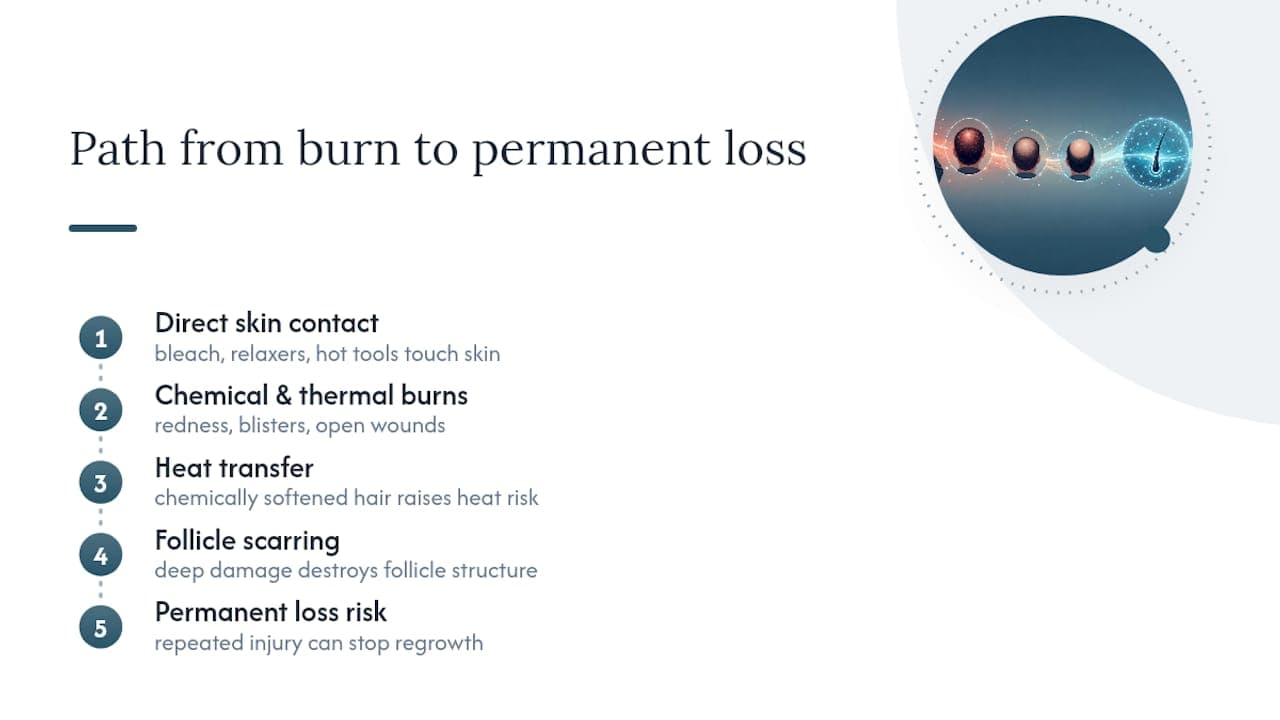
The scalp injury risk gets less attention than hair breakage, but it's arguably the more serious concern for anyone worried about permanent hair loss. Bleach, relaxers, and hot tools all make direct contact with skin, not just hair, and that skin can burn.
Chemical burns happen when relaxers or strong lighteners sit too long or touch broken skin, causing redness, blistering, and in severe cases, open wounds. Thermal burns come from flat irons, curling irons, or foil used during processing, sometimes made worse because chemically softened hair transfers heat differently than untreated hair.
The follicle itself lives below the skin's surface, and it's remarkably good at regenerating after minor irritation. Scarring changes that. When a burn damages the follicle deeply enough to destroy its structure, permanently, according to the Frontiers in Medicine review on hair dyeing and perming, no amount of product or patience brings that hair back. This condition, sometimes called scarring alopecia when it results from repeated injury, is one of the few forms of hair loss with no regrowth path.
That's the core reason dermatologists push back so hard on repeated aggressive chemical services, especially in the same spot on the scalp. A single overprocessed appointment might cause temporary irritation. Years of repeated bleaching, relaxing, or high-heat contact in the same area raise the odds that irritation eventually crosses into permanent follicle loss.
What Years of Harsh Treatments Do to Hair Density and Texture
Damage from a single bad appointment usually grows out. Damage from years of repeated harsh treatments behaves differently, because it compounds faster than hair can replace itself.
Hair density (how many strands per square inch of scalp) can drop when repeated breakage outpaces regrowth, especially near the hairline and part line where friction and product application concentrate. This shows up as hair that looks visibly thinner even without classic pattern hair loss.
Texture changes are just as common. Curl pattern can loosen permanently after repeated relaxer use, and hair that once held curl or wave lies flatter and feels different to the touch. This isn't just cosmetic frustration. Altered texture usually signals that the cortex itself, the part of the hair responsible for shape and elasticity, has sustained lasting structural change.
The most serious long-term outcome is scarring alopecia, where repeated chemical or thermal injury to the follicle triggers inflammation that replaces normal follicle tissue with scar tissue. Once that happens in a given spot, hair does not grow back there. It's a slow process, usually built from years of repeated aggressive treatments rather than one incident, which is exactly why prevention matters more than damage control after the fact.
Coping With Hair Damage: The Emotional Side Nobody Talks About
Hair loss and visible damage carry a psychological weight that goes beyond appearance. For many people, hair is tied closely to identity, confidence, and how they feel walking into a room. Watching it thin, break, or change texture after treatments can trigger real grief, not just annoyance.
It's common to feel embarrassed, avoid social situations, or fixate on new fixes that sometimes make things worse. Chasing one more treatment to correct damage from the last one is a pattern worth recognizing before it starts, because it usually adds more chemical or thermal stress to hair that needs the opposite.
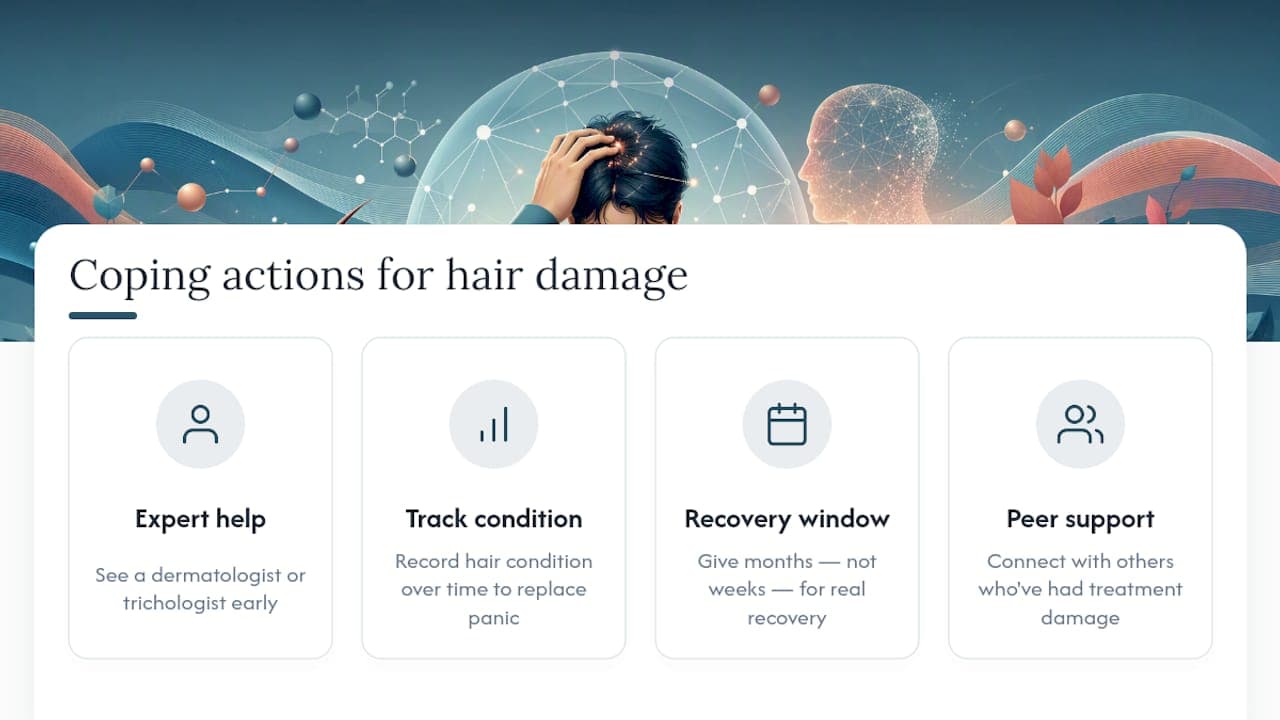
A few things genuinely help. Talking to a dermatologist or trichologist early gives you a realistic picture instead of a guessing game, which on its own reduces anxiety for a lot of people. Tracking your hair's actual condition over time, rather than relying on memory or mood, replaces panic with information. Giving yourself a real recovery window, often months rather than weeks, sets expectations that match how hair actually heals. And connecting with others who've dealt with treatment-related damage can make the experience feel less isolating.
None of this erases the frustration of dealing with damaged hair. But grounding your next decision in actual data instead of another appointment tends to be the thing that breaks the cycle.
A Data-Driven Way to Decide What to Skip Next
Most people decide whether to risk another treatment based on guesswork or a stylist's reassurance. Myhair takes a different approach: an AI scan reads your hair's current condition, flagging signs of chemical weakening or heat sensitivity before you book anything else. A personalized assessment can point out when hair needs spacing or a gentler alternative instead of another aggressive round, turning a subjective decision into one grounded in your own hair's actual state.
— Cyriac
Check Your Hair Before You Book Another Treatment
Before you commit to another round of bleach, relaxer, or high heat, it's worth knowing where your hair actually stands. Myhair's free plan lets you run a scan and get a real read on your hair's current condition before you spend money or risk more damage.
The AI scanner analyzes porosity, breakage patterns, and thermal sensitivity from your own photos, then gives you tailored product and care recommendations instead of generic advice. If your scan flags heavier damage or thinning, the platform's clinic directory and hair restoration doctor listings connect you to professionals who can take it further. The subscription plan tracks changes over time, so you can see whether your current routine is helping or quietly working against you. Current prices are available on the pricing page.
Start with the free scan before your next salon appointment. It takes a few minutes and gives you something no stylist consultation can: an objective baseline for your own hair.
Sources
- Mechanisms of impairment in hair and scalp induced by hair dyeing and perming and potential interventions — Frontiers in Medicine
- Hair smoothing products that release formaldehyde when heated | FDA
- Review: adverse effects associated with hair straightening and relaxer products — PMC
- Thermal induced changes in cuticle and cortex to chemically treated hair — PMC
- Chemicals in shampoo that cause hair loss — Medical News Today
FAQ
Can Bleaching Really Cause Permanent Hair Loss?
Bleaching itself mainly damages the hair shaft rather than the follicle, causing breakage that grows out over time. Permanent loss becomes a risk only when bleach causes scalp burns or repeated irritation deep enough to scar the follicle, a rarer but real outcome tied to scalp injury from chemical treatments.
Is It Safe to Get a Keratin Treatment if I'm Already Losing Hair?
Some keratin and smoothing treatments release formaldehyde gas when heated, which the FDA has flagged for irritation and health risks. If you're already concerned about hair loss, it's worth checking your hair's condition first and asking your salon about formaldehyde-free formulas and ventilation.
How Long Should I Wait Between Chemical Treatments?
Most dermatologists and stylists recommend spacing aggressive chemical services at least six to eight weeks apart to let the cuticle and cortex partially recover. Combining treatments like bleach and relaxer in the same visit removes that recovery window entirely.
Does Myhair Replace a Dermatologist Visit?
No. Myhair's AI scan gives you a personalized read on hair condition and product fit, which is useful for deciding whether to pause treatments, but it doesn't replace a clinical exam. For red-flag symptoms like scalp burns or patchy loss, the platform's directory of hair restoration doctors points you to a specialist.
What's the Biggest Sign My Hair Can't Handle Another Treatment?
Ongoing breakage that doesn't improve with gentler care, combined with visible thinning or scalp sensitivity, usually means your hair needs a break rather than another procedure. A scan or professional pull test can confirm whether you're dealing with shaft damage alone or something affecting the follicle itself.