Blog
Learning Materials
Restore Damaged Hair: Best AI-Recommended Treatments
Updated: April 20, 2026
TL;DR:
- AI diagnostics identify specific hair damage types for personalized treatment.
- Bond repair treatments and nutraceuticals are most effective for structural hair recovery.
- Consistent routine and monitoring over months are essential to see lasting results.
Damaged hair does not fix itself. If you have tried every mask, serum, and deep conditioning treatment on the shelf and still see breakage, dullness, and split ends, you already know that generic solutions rarely deliver real results. The problem is not effort. It is fit. Without understanding the specific cause of your damage, whether chemical, heat, mechanical, or environmental, you are essentially guessing. This guide walks you through the science of hair repair, the products that actually work, how to build a routine tailored to your unique hair condition, and how AI technology can make every step faster and more precise.
Table of Contents
- Understanding hair damage and the role of technology
- Essential products and tools for damaged hair repair
- How to create your personalized hair treatment routine
- Measuring progress: Tracking recovery and adjusting products
- Why the future of hair repair is personalized — and smarter than ever
- Ready to transform your hair? Start with MyHair's AI analysis
- Frequently asked questions
Key Takeaways
| Point | Details |
|---|---|
| Personalized repairs work best | AI-driven analysis helps match you with the most effective hair treatment products for your specific damage. |
| Bond repair is clinically proven | Modern bond repair solutions and nutraceutical supplements visibly strengthen and thicken damaged hair over time. |
| Routine and tracking matter | Sticking to a tailored regimen and monitoring your progress lead to the best long-term hair recovery results. |
| Results are measurable | You can see and feel improvements like stronger, more elastic hair within weeks to months when using the right products. |
Understanding hair damage and the role of technology
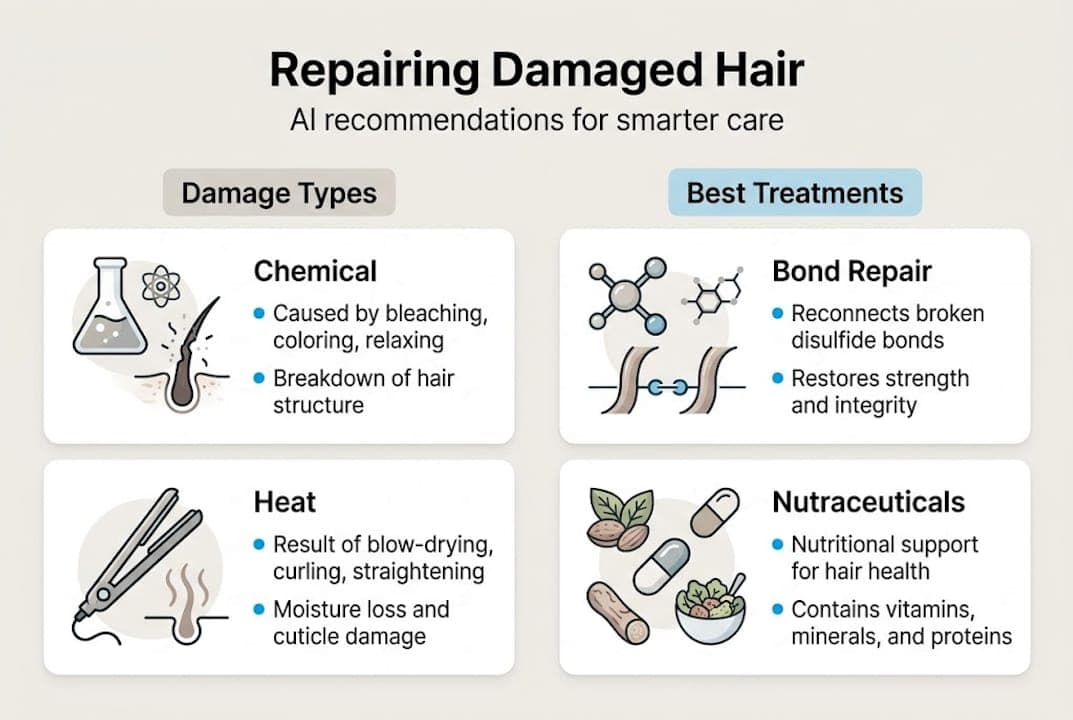
Hair damage is not one single thing. It shows up in four distinct forms, and treating the wrong type with the wrong product is one of the most common mistakes people make.
The four main types of hair damage:
- Chemical damage: Bleaching, coloring, perming, and relaxing break the disulfide bonds inside the hair cortex. This leaves strands porous, weak, and prone to snapping. If you want a deeper look at this specific problem, over-processed hair insights can help clarify what is actually happening inside each strand.
- Heat damage: Repeated flat iron and blow dryer use degrades the protein structure, causing the cuticle to lift and frizz to set in permanently.
- Environmental damage: UV radiation, hard water minerals, and pollution coat the hair shaft and disrupt the moisture barrier over time.
- Mechanical damage: Tight ponytails, rough towel drying, and aggressive brushing physically fracture strands, especially at points of tension.
Conventional products treat symptoms, not causes. A hydrating shampoo will not fix a broken bond. A protein mask will not undo mineral buildup. This is why the "one-size-fits-all" approach leaves most people cycling through products with inconsistent results.
The science has caught up, though. Bond repair technology, originally developed for salon chemical services, works by rebuilding the broken internal links inside each strand. Tensile strength and elasticity both improve with consistent bond repair use, and nutraceutical supplementation has been shown to increase hair shaft diameter significantly over 6 months in controlled trials.
| Damage type | Primary cause | Key treatment approach |
|---|---|---|
| Chemical | Color, bleach, perms | Bond repair, protein treatments |
| Heat | Styling tools | Thermal protection, moisture |
| Environmental | UV, pollution, hard water | Antioxidant serums, chelating shampoo |
| Mechanical | Brushing, tension | Strengthening masks, gentle handling |
AI diagnostics change the starting point entirely. Instead of guessing your damage type, an AI-powered scan maps your scalp and strand condition at a granular level. It reads patterns in your hair density, texture shifts, breakage zones, and porosity signals, then matches those findings directly to evidence-based product categories. That kind of specificity is what separates a result from a routine.
Essential products and tools for damaged hair repair
Once you know your damage profile, you can stop wasting money on the wrong products. Here are the core categories every damaged hair regimen should include, along with how to choose within each one.
Core product categories:
- Bond repair treatments: These are non-negotiable for chemically damaged hair. Look for ingredients like maleic acid, bis-aminopropyl diglycol dimaleate, or similar bond-building compounds.
- Leave-in conditioners: These form a protective layer that reduces friction and locks in moisture between washes. Lightweight formulas work best for fine hair; richer creams suit coarser or very porous strands.
- Intensive masks: Used once or twice weekly, these deliver concentrated protein or moisture depending on what your hair is lacking. Not both at once.
- Serums and oils: Targeted at sealing the cuticle and adding surface shine. Argan, marula, and camellia oils rank among the highest performers for damaged hair.
- Supplements and nutraceuticals: Internal support matters. Hair shaft diameter increases measurably over six months with targeted nutraceutical use, which means what you eat and supplement directly affects your results. For a breakdown of which supplements are worth your time, see this guide to supplements for hair growth.
| Product type | Best for | Frequency |
|---|---|---|
| Bond repair treatment | Chemical damage | 1 to 2x per week |
| Intensive protein mask | Weak, stretchy hair | Every 10 to 14 days |
| Moisture mask | Dry, brittle strands | Weekly |
| Leave-in conditioner | All damaged hair types | Every wash day |
| Scalp serum | Thinning, irritated scalp | Daily |
AI-powered hair analysis makes product selection precise rather than intuitive. When MyHair.ai scans your hair condition, the system identifies whether your strands are protein-deficient or over-proteinated, whether moisture levels are adequate, and what density changes suggest about your hair cycle. It then maps those findings to the essential hair recovery products most likely to produce results for your specific profile.

Pro Tip: Always apply bond repair before your conditioner, not after. Bond repair needs direct contact with the cortex to work. Conditioner applied first seals the cuticle and blocks penetration. Layer in this order: bond repair, rinse, conditioner, leave-in.
How to create your personalized hair treatment routine
Having the right products is only half the equation. The order, frequency, and combination of what you use determines whether you get results or just spend money.
Step-by-step routine building:
- Start with an honest assessment. Before buying anything, scan your hair using an AI tool or answer a detailed diagnostic questionnaire. Identify whether your primary issue is protein loss, moisture deficiency, scalp imbalance, or breakage.
- Select products by damage type. Use your assessment to narrow down to two or three core products. Resist the urge to overload your routine.
- Set a consistent schedule. Bond repair once or twice weekly. Intensive mask every ten days. Leave-in every wash. Supplement daily. Predictability matters more than intensity.
- Run the routine for at least eight weeks. Hair repair is slow. Visible changes in elasticity and breakage reduction typically appear between weeks four and eight. Structural changes, like increased shaft diameter, take longer.
- Adjust based on response. If hair feels hard and straw-like, reduce protein and increase moisture. If it stretches without snapping back, add protein. This is where regular AI monitoring becomes invaluable.
"The biggest mistake in hair repair is changing products too quickly. Most people switch before the treatment has had time to work, which means they never experience the full benefit of anything they try."
Clinical research reinforces this patience. Bond repair protocols improve tensile strength and elasticity over consistent use, and nutraceutical effects on hair shaft diameter reach significance at the six month mark. For detailed guidance on what to look for in supplement form, this resource on choosing hair care supplements offers practical selection criteria.
Pro Tip: Take a weekly photo of a consistent section of your hair under the same lighting. You will not notice gradual improvement day to day, but comparing week one to week eight is often dramatic.
Safety note: Never apply a protein mask and a moisture mask in the same session. Protein overload causes brittleness. Moisture overload causes limpness and stretch. Alternate them based on how your hair feels.
Measuring progress: Tracking recovery and adjusting products
If you are not tracking your hair's response, you are guessing whether your routine is working. Objective markers make the difference between a routine that adapts and one that stagnates.
What to monitor regularly:
- Elasticity: Wet hair should stretch roughly 30% before returning to its original length. Less stretch means it is brittle. No return means it is over-moisturized.
- Breakage count: After detangling, count the number of broken strands. A decline over four weeks confirms the routine is working.
- Shine: Cuticle health directly reflects light. Dull hair means the cuticle is lifted. Increasing shine is one of the earliest visible signs of repair.
- Density and diameter: These take longer but are the most meaningful. Thicker strands and maintained density signal real structural recovery.
| Milestone | Typical timeline | What it means |
|---|---|---|
| Reduced breakage | Weeks 3 to 5 | Strand integrity improving |
| Improved elasticity | Weeks 4 to 6 | Moisture and protein balance restored |
| Visible shine | Weeks 4 to 8 | Cuticle closing and smoothing |
| Increased strand diameter | Months 4 to 6 | Deep structural recovery confirmed |
Hair shaft diameter increases significantly after six months of consistent nutraceutical use in clinical settings, which tells you two things. First, internal support works. Second, real results take time and commitment.
Digital tools accelerate this process. MyHair.ai's tracking feature logs your hair score across multiple scans, giving you a timeline of change rather than a single data point. When you compare scan results over weeks and months, you can see exactly where improvement has occurred and which areas need a different approach. For specific products that align with each stage of recovery, explore these hair recovery product options.
When to switch products: If you see no change in elasticity or breakage after six weeks of consistent use, that product category is not addressing your primary damage type. Use your scan data as the signal, not your gut feeling.
Why the future of hair repair is personalized — and smarter than ever
Here is something most hair care articles will not say directly: the era of browsing shelves based on packaging promises is over for anyone serious about results. Generic formulas were designed for average hair, which means they are optimized for no one in particular.
What AI-driven diagnostics bring to the table is not just convenience. It is a fundamentally different starting point. Instead of treating symptoms with whatever is trending, you are treating causes with products matched to your specific biology. That distinction produces faster, more visible, and more lasting outcomes.
We believe the next generation of hair repair will look less like a shelf of products and more like a feedback loop. Scan your hair. Receive personalized recommendations. Use them. Track your score. Adjust. Repeat. Every iteration makes the next one smarter. That model, grounded in clinical evidence and individual data rather than broad assumptions, is what actually moves the needle.
The most impressive results we see come from people who combine expert hair repair recommendations with regular AI monitoring. Not because the products are magic, but because they are the right products, used in the right way, with real data guiding every adjustment.
Ready to transform your hair? Start with MyHair's AI analysis
You now have a clear picture of what damaged hair needs and how to build a routine that actually works. The next step is making it personal.
MyHair.ai's AI-powered hair analysis scans your hair and scalp condition in minutes, delivering a detailed assessment and personalized product recommendations matched to your exact damage profile. No more guessing. No more wasted purchases. When you get started with MyHair, you access a system designed to evolve with your hair as it heals. You can also track your hair score over time to measure real progress at every stage of your recovery.
Frequently asked questions
How soon can I see results from hair treatment products for damaged hair?
Measurable improvements in hair diameter appear within six months of consistent treatment, while improvements in strength and elasticity often become noticeable sooner, around weeks four to six.
What is the most effective ingredient for repairing damaged hair?
Bond repair compounds and nutraceutical ingredients are currently the most clinically supported options, with studies confirming improvements in tensile strength and shaft diameter over consistent use.
How does AI technology help choose the right products for my damaged hair?
AI-driven hair analysis identifies your specific damage type and severity, then matches those findings to products most likely to address your exact condition rather than a general hair type.
Should I use supplements alongside topical treatments for damaged hair?
Yes. Combining topical treatments with targeted supplements addresses both external strand integrity and the internal factors that drive growth, resulting in more complete and lasting recovery.