Blog
Learning Materials
Spot Buildup Fast: Signs by Texture and 5 At Home Tests
Updated: September 21, 2026

If your hair feels waxy right after you shampoo, looks flat no matter how much mousse you add, and there's a filmy residue at your part line, you're almost certainly dealing with product buildup, not dandruff. The clearest tell is that waxy or coated feeling combined with limp volume. Do a single clarifying wash and see if shine and bounce come back within a day. If flaking, itching, or soreness persists after that, it points toward a scalp condition rather than simple residue, and a source like Myhair or a clinical review can help you tell the difference.
TL;DR:
- Most product buildup causes a greasy, waxy feel and dullness that improves quickly with clarifying shampoo, but persistent flaking may indicate a scalp condition.
- Buildup on straight or fine hair shows as rapid grease at the roots or flatness, while curly or coily hair reveals uneven curl definition, increased tangling, or loss of spring.
- Common culprits include silicones, waxes, heavy oils, dry shampoo starches, and minerals from hard water, which layer on the hair shaft and resist rinsing.
- At-home tests like foaming ability, brushing, and water bead resistance can confirm buildup; ongoing symptoms or sores require professional evaluation.
- Preventative habits include rotating lighter products, avoiding applying heavy oils on roots, rinsing thoroughly, and using filters or chelating shampoos for hard water issues.
Table of Contents
- Signs of Product Buildup You Can See and Feel
- How Buildup Looks Different Depending on Your Hair Type
- What Actually Causes Product Buildup
- Quick At-Home Tests to Confirm Buildup
- When Buildup Becomes a Medical Concern
- How to Remove Buildup Without Overdoing It
- Simple Habits That Keep Buildup From Coming Back
- Getting a Clearer Read With MyHair.ai
- What People Get Wrong About Treating Buildup
- A Guided Alternative When You Want a Second Opinion
- Sources
- FAQ
Signs of Product Buildup You Can See and Feel
Buildup rarely announces itself with one dramatic symptom. It shows up as a cluster of small, annoying changes that get worse the longer you ignore them. Here's what to check first.
Hair that looks dull despite being technically clean is one of the earliest tells. Buildup roughens the outer cuticle layer, and a rough surface scatters light instead of reflecting it, which is why healthy strands can suddenly look flat or darker than usual. This isn't damage in the traditional sense. It's a coating problem, and it often clears up within one or two washes once the residue is gone.
Weight is another giveaway. If your hair feels heavier than normal and your usual volumizing routine stops working, product residue is likely sitting on the shaft and dragging it down. This matters more for fine or thin hair, where even a small amount of extra weight can flatten a whole style.
Greasy or waxy hair soon after washing is the symptom most people notice first, and it's often misread as an oil problem. Try this simple lather test: if your shampoo barely foams even after a full application, that's a sign the surfactants are being used up neutralizing residue instead of cleaning your scalp. Clinical explanations of scalp physiology note that occlusive substances can interfere with how sebum moves along the hair shaft, which is part of why coated hair seems to get oily faster than it actually is producing oil.
Residue at the part line or on your brush is the most concrete, visual sign of all. It typically looks like a thin white or grayish film, waxy to the touch, sitting close to the scalp, and it doesn't flake off the way dandruff does. Dandruff tends to be drier, more scattered across the scalp surface, and often comes with redness or itching. Buildup residue clings.
A few more signs worth tracking:
- Leave-in conditioners or serums stop absorbing and instead sit on top of the hair, feeling sticky or tacky.
- Tangles increase, especially single-strand knots, because a coated cuticle has less natural slip.
- A faint, stale odor lingers at the roots even after washing, especially with dry shampoo users.
- Curls or waves lose their usual pattern, going looser, frizzier, or less defined without any change in humidity or product routine.
Statistic Callout: Research on topical scalp agents shows that certain residue-forming ingredients can alter the follicular environment and contribute to irritation when they accumulate over time, which is one reason dermatologists treat persistent buildup as more than a cosmetic annoyance.
Health explainers echo this pattern, describing buildup-related flakes as a mechanical residue problem that responds to clarifying rather than a skin condition needing medication, which is detailed in Healthline's overview of scalp buildup.
How Buildup Looks Different Depending on Your Hair Type
Straight hair shows buildup fast and visibly. Oil travels quickly down smooth strands, so you'll see shine turn to grease at the roots within a day or two, and lengths go flat under the extra weight.
Wavy hair tends to show a mixed picture. Roots flatten while the mid-shaft frizzes, and the wave pattern you're used to seeing loses its shape, often looking limp on top and rough below.
Curly hair hides buildup differently. Ends can feel dry even while the scalp underneath is coated, curl definition turns patchy or uneven, and tangling increases because the cuticle has less slip to work with.
Coily hair often loses spring first. Curls that normally bounce back start hanging looser, single-strand knots multiply, and residue collects visibly near the part where product tends to sit.
Match your self-check to your texture:
- Straight hair: part and inspect at the crown, where oil shows up first.
- Wavy hair: check mid-shaft frizz alongside root flatness.
- Curly hair: do a curl clump test, looking for uneven definition strand to strand.
- Coily hair: watch for spring loss and check the part line for visible film.
What Actually Causes Product Buildup
Most buildup traces back to a handful of repeat offenders, and once you know their names, label reading gets a lot easier.
Silicones like dimethicone are the biggest culprits because they coat the hair shaft to create shine and smoothness, but heavier, non-water-soluble versions don't rinse out with a standard shampoo. Waxes, heavy oils, and certain film-forming polymers behave the same way, layering on top of each other with every application.
Dry shampoo is a quieter contributor. Its starches absorb oil at the root, but they don't wash away on their own, and if you're spraying it daily between washes, that starch compounds fast. Leave-in conditioners and styling creams add to the pile when they're layered without a thorough rinse in between.
Hard water plays a role too. Calcium and magnesium minerals react with soap-based cleansers to form a film that behaves exactly like product residue, which is why some people struggle with buildup no matter what they put in their hair.
- Watch for ingredient names like dimethicone, cyclomethicone, beeswax, and PVP on the label.
- "Water-soluble silicone" (often listed as a PEG or PPG-modified dimethicone) rinses out far easier than standard silicones.
- The FDA maintains public guidance on regulated cosmetic ingredients, including parabens and their approved uses, which is a useful reference if you're trying to understand what's actually allowed in your products.
Pro Tip: Scan ingredient lists for anything described as a "polymer" or "film former," and save the heaviest formulas for length and ends rather than the scalp. Roots need less coating than you think.
Quick At-Home Tests to Confirm Buildup
Before you overhaul your routine, run these checks. They take one wash cycle and settle the question fast.
- Lather test: shampoo once as usual. If it barely foams, residue is likely soaking up the surfactant before it can clean.
- Brush and part inspection: look for a waxy film at the scalp or on your brush bristles. Dandruff flakes are drier and scatter; buildup clings.
- Dry texture check: once hair is fully dry, run your fingers through it. A tacky or coated feel points to buildup rather than natural dryness.
- Curl or wave hold test: note how your pattern behaves before a clarifying wash, then check again after. A clear improvement confirms residue was the issue.
- Rinse difficulty test: if water beads on your hair instead of soaking in during a rinse, that's a sign of heavy silicones or wax resisting the water.
When Buildup Becomes a Medical Concern
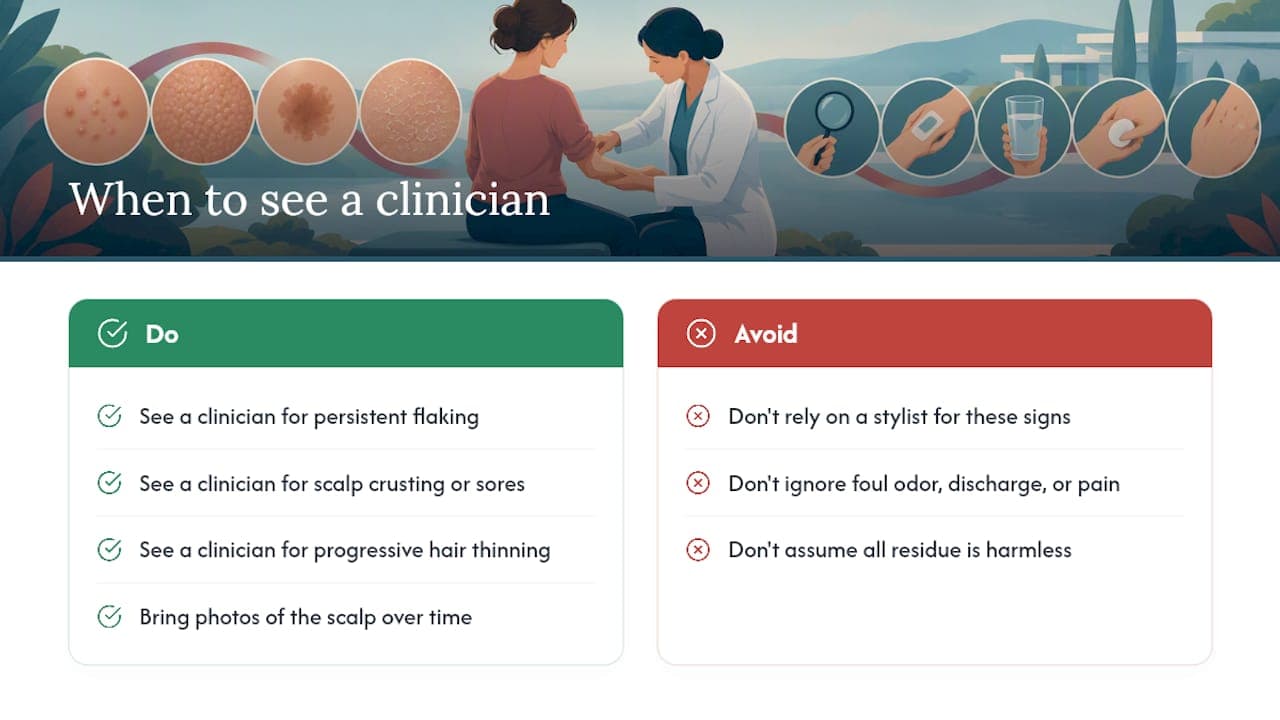
Most buildup clears with a clarifying wash. It's a different story if flaking continues unchanged, the scalp develops crusting or sores, or you notice progressive hair thinning alongside the residue. Foul odor, discharge, or pain are signs to see a clinician, not a stylist. Bring photos of the scalp over time. A dermatologist or trichologist will check for inflammation, infection, or a condition like dandruff on a bald scalp that mimics buildup but needs a different treatment path entirely.
How to Remove Buildup Without Overdoing It
Removal doesn't need to be aggressive. It needs to be targeted.
- Use a clarifying shampoo once every one to four weeks, depending on how much product and dry shampoo you use. Heavy stylers or daily dry shampoo users lean toward weekly; minimal product users can go monthly.
- Try a gentler alternative if your scalp is sensitive: an apple cider vinegar rinse (diluted, roughly one part vinegar to three or four parts water) cuts residue without the harsh strip of a full clarifying formula. Skip baking soda regularly. It's alkaline enough to disrupt your scalp's natural pH over time.
- Deep condition immediately after clarifying. Stripping removes buildup, but it also removes some natural moisture, so follow with a rich conditioner and go light on leave-ins for a day or two while slip returns.
- If hard water is the suspected cause, a chelating shampoo or an inline shower filter addresses the mineral film directly, since a standard clarifying shampoo alone won't fully solve that particular problem.
Pro Tip: Don't clarify and deep-condition on the same day you use heat styling. Give your hair a rest day in between so you're not layering stress on freshly stripped strands.
Simple Habits That Keep Buildup From Coming Back
Prevention is mostly about rotation and restraint, not buying new products.
- Alternate heavier styling formulas with lighter ones through the week instead of using the same rich product daily.
- Keep oils and heavy creams off the scalp itself. Apply them mid-shaft to ends only.
- Rinse thoroughly, and resist stacking three or four leave-in products in a single routine.
- Cap dry shampoo at two to three uses between washes, and set a clarifying wash on your calendar based on how much you style.
- If your water is hard, a filter or an occasional chelating rinse prevents the mineral film from forming in the first place.
Getting a Clearer Read With MyHair.ai
When signs are subtle or keep recurring, a photo-based scan through Myhair can track shine, density, and scalp condition over time, which helps separate a temporary styling issue from a real pattern. The platform's research library and posts on tracking signs of improvement go deeper if you want to combine a self-check with a data-backed second opinion.
What People Get Wrong About Treating Buildup
The most common mistake is treating buildup like dryness and piling on more conditioner, which only adds to the coating. A single clarifying wash is a low-risk test, not a commitment. Track results with photos before and after so you're judging real change, not memory.
— Cyriac
A Guided Alternative When You Want a Second Opinion
Running the self-checks above will settle most buildup questions. When the picture stays murky, or you want product recommendations that actually fit your hair instead of guessing off a label, MyHair.ai gives you a photo-based scan that scores hair health and flags changes over time.

The free plan lets you run an initial AI hair analysis and get a baseline hair score without committing to anything. If you want ongoing tracking and tailored product suggestions as your routine changes, the monthly plan runs $9.99, with a yearly option also available. For anyone whose scalp symptoms look more serious than simple residue, the platform's clinic directory connects you with professionals instead of leaving you to guess. Start with a scan at Myhair and see what your hair score actually says before you buy another product.
Sources
- NCBI review — topical agents and scalp health (PMC9373925)
- Healthline — Scalp buildup: Causes, signs, and how to treat
- FDA — Parabens in cosmetics
FAQ
How Do I Get Rid of Product Buildup?
A clarifying shampoo used once, followed by a deep conditioner, resolves most cases within a single wash. If shine and slip don't return after a second try a week or so later, hard water or heavy silicones may need a chelating rinse or filter.
What Does Product Buildup Actually Look Like?
It shows up as a waxy or greasy feel soon after washing, dullness despite clean hair, and a thin film at the part line or on your brush. Unlike dandruff, the flakes don't scatter dry across the scalp. They cling and feel coated, as Healthline's guide on scalp buildup describes.
Why Do I Get Product Buildup So Fast?
Heavy silicones, waxes, and dry-shampoo starches layer quickly if they're not fully rinsed between uses, and hard water minerals can compound the problem by reacting with your shampoo to form a residue film. Fine or straight hair tends to show it fastest because there's less natural texture to hide the extra weight.
What Are the Worst Shampoos for Thinning Hair?
Formulas loaded with heavy, non-water-soluble silicones and waxy conditioning agents tend to weigh thinning hair down and can worsen the look of limpness over time. A photo-based scan through Myhair can help track whether a specific shampoo is making your hair look thinner or if the pattern points to something else entirely.
Is Product Buildup the Same as Dandruff?
No. Buildup is residue sitting on the hair and scalp, while dandruff is a skin condition tied to inflammation or fungal activity. Buildup responds to clarifying washes, while dandruff usually needs a medicated approach, a distinction covered in more depth in Myhair.