Blog
Learning Materials
Track Winter Hair Shedding: Start With a 6–8 Week AI Scan
Updated: August 30, 2026
Mild to moderate winter shedding is common and usually temporary. It typically traces back to a hair-growth cycle that peaked months earlier, not a new problem. The right first move isn't panic or a new supplement stack. It's tracking your hair over several weeks, tightening a few daily habits, and watching for red flags like patchy loss or thinning that drags past three months.
TL;DR:
- Most winter shedding is a delayed response to summer hair growth cycles and is usually temporary if habits are improved.
- Environmental stressors like low humidity, hot water, and friction from clothing significantly contribute to increased breakage and shedding during winter.
- Red flags such as patchy bald spots or persistent scalp inflammation indicate potential issues beyond seasonal shedding that require medical evaluation.
- Objective tracking with repeated photos or scans over six to twelve weeks provides a reliable way to assess whether habits are improving shedding trends.
- Gentle hair care, reducing heat styling, and managing indoor humidity can significantly reduce breakage and support hair recovery through improved habits within weeks.
Table of Contents
- Why Does Hair Shed More In Winter?
- Seasonal Shedding Or Something Else?
- Building A Winter Hair Care Routine That Actually Works
- What To Expect If Winter Habits Don't Fix It
- How Tracking Removes The Guesswork
- Why Measurement Beats Guessing With Winter Shedding
- Start Tracking Your Hair With Myhair
- Sources
- FAQ
Why Does Hair Shed More In Winter?
Winter hair loss usually isn't caused by winter itself. It's the delayed echo of something that happened months earlier. A 2009 study tracking 823 women found that the proportion of hair follicles in telogen, the resting phase before shedding, peaks in late summer and early autumn. Hair doesn't fall out the moment it enters telogen. It sits dormant for weeks before releasing, which means shedding that started as a late summer cycle often shows up as a handful of extra hairs on your pillow in December and January.
On top of that biological lag, winter piles on its own environmental stressors:
- Lower scalp sebum production, which leaves strands drier and more prone to snapping
- Indoor heating and low humidity, which strip moisture from both hair and scalp
- Static and friction from wool hats, scarves, and synthetic fabrics
- Trapped moisture under hats, which can irritate the scalp barrier
- Reduced sunlight exposure, tied to lower vitamin D synthesis
- Habitually hotter shower water, which dries out the scalp faster than lukewarm water
One distinction matters more than people realize: breakage and follicular shedding look similar but aren't the same thing. Breakage snaps the hair shaft mid-strand, leaving short, frayed pieces. Shedding pulls a full strand, root and all, out of the follicle. Dermatologist-sourced healthy hair guidance points out that most winter complaints are actually breakage from dry, brittle strands, not true hair loss. Knowing which one you're dealing with changes what you should fix first.
Seasonal Shedding Or Something Else?
Most winter shedding resolves on its own within a few months. A smaller share of cases signals something that needs a closer look. Watch for these red flags:
- Patchy or localized bald spots, rather than diffuse thinning across the scalp
- A widening part or receding hairline that follows a predictable pattern over months
- Scalp inflammation, redness, itching, or scaling that doesn't clear up
- Shedding that persists beyond three months without slowing down
- Sudden, dramatic shedding tied to illness, fever, major stress, or a new medication
You don't need a dermatologist to start gathering evidence. Take a photo of your part line and hairline under consistent lighting once a week. Count strands during a single wash and jot the number down. A seasonal-shedding overview from a hair clinic notes that telogen effluvium, the medical term for diffuse shedding after a trigger, often surfaces two to three months after the actual cause, which is exactly why a single bad hair day tells you almost nothing on its own.
If shedding crosses into red-flag territory, a clinical workup usually starts with a history and scalp exam, followed by blood tests for iron levels, thyroid function, and vitamin D. These three come up constantly because deficiencies in any of them mimic seasonal shedding almost perfectly.
Pro Tip: Take your baseline photos before you change anything about your routine. If you start a new shampoo and your scalp improves, you want to know it was the shampoo and not just the season turning.
Building A Winter Hair Care Routine That Actually Works
Fixing winter hair rarely requires a dramatic overhaul. It requires a handful of small, consistent changes that stop the damage before it compounds.
Start with what touches your scalp and hair most often. Swap harsh, sulfate-heavy shampoos for gentler cleansers, and look for humectants like glycerin or hyaluronic acid in your conditioner. These ingredients pull moisture into the hair shaft instead of coating it, which matters because dermatology guidance on healthy hair care recommends applying shampoo to the scalp and conditioner to the strands, treating the two zones differently. Skip medicated or anti-dandruff shampoos unless a professional has actually diagnosed dandruff. Using them preventively just strips moisture you're trying to preserve.
Adjust the mechanics of washing and styling:
- Wash with lukewarm water instead of hot. Hot water strips the scalp's natural oils faster than any product can replace them.
- Detangle with a wide-tooth comb, starting at the ends and working up, especially on wet hair.
- Cut back on heat styling frequency, or add a heat protectant when you can't skip it.
- Switch pillowcases and hat linings to silk or satin, which cause far less friction than cotton or wool.
- Wash hats, scarves, and hoods weekly. Trapped sweat and oil against the scalp under a cap breeds irritation.
- Loosen tight ponytails, buns, and braids. Winter is not the season for high-tension styles.
A weekly pre-wash oiling with a lightweight oil can help seal in moisture before it's stripped by washing, though it's a supplement to humectant-based care, not a replacement. One detail worth knowing: dermatologists interviewed by Byrdie point to indoor heating as a bigger culprit than outdoor cold for most people, since central heating drops indoor humidity well below what skin and scalp are built for. Running a humidifier in the room where you sleep addresses that root cause directly, rather than just treating the symptoms downstream.
What To Expect If Winter Habits Don't Fix It
Habit changes work faster than most people expect, but not overnight. Reduced breakage from gentler washing and better hydration usually shows up in two to six weeks. Visible density recovery, meaning noticeably fuller-looking hair, takes longer: typically three to six months, since that's roughly how long it takes new growth to become visually apparent.
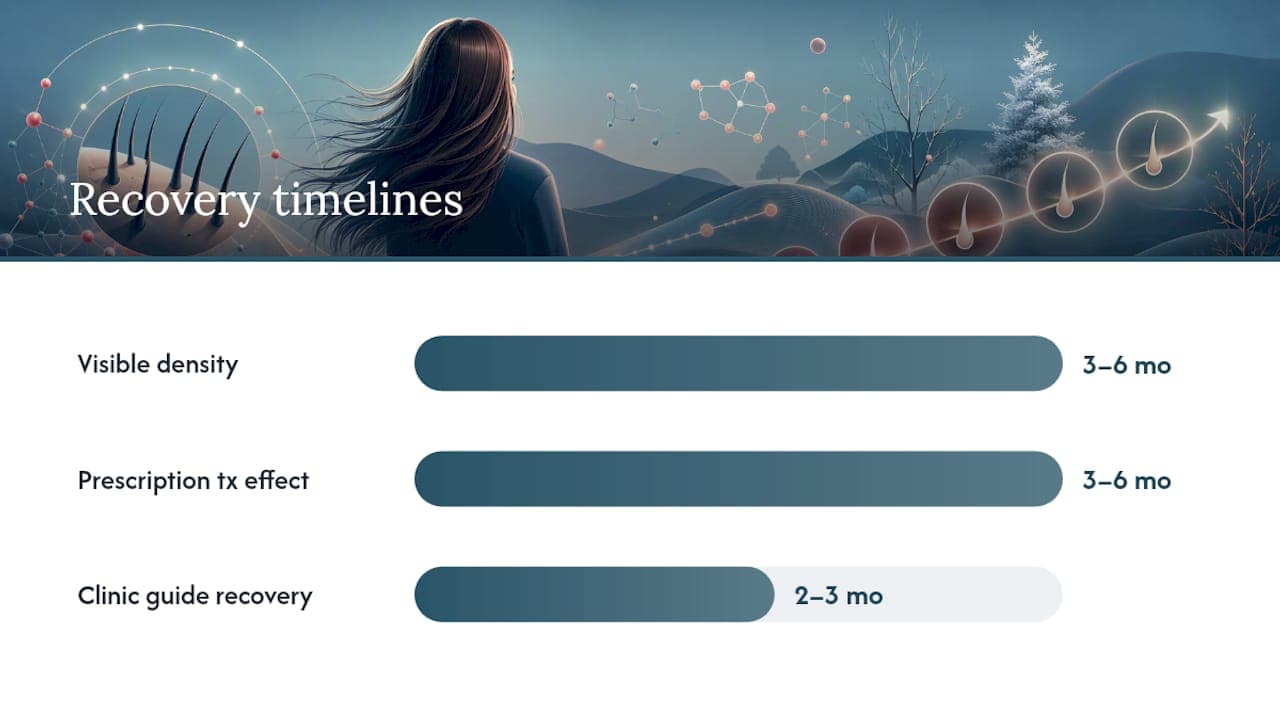
If nothing improves on that timeline, the distinction between telogen effluvium and androgenetic alopecia becomes important. Telogen effluvium is diffuse, temporary, and tied to a trigger; it resolves once the trigger clears and the cycle resets. Androgenetic alopecia is progressive, pattern-based, and driven by genetics and hormones. It requires an entirely different approach, and prescription treatments for it often take three to six months to show any measurable effect because they work by shifting follicles into a longer growth phase, not by regrowing hair overnight.
Before reaching for supplements or prescription medication, targeted testing matters more than most product marketing suggests:
- Confirm actual iron, thyroid, and vitamin D levels rather than guessing
- Rule out recent illness, crash dieting, or medication changes as triggers
- Reassess after habit fixes have had their full two to six week window before adding anything new
A clinic guide on winter hair triggers estimates recovery in the two to three month range once reversible triggers like friction and trapped moisture are corrected, which lines up closely with the habit-fix timeline above.
How Tracking Removes The Guesswork
Comparing one bad hair day to a memory of last spring is a bad way to measure anything. Clinicians who study seasonal hair cycles warn that misreading normal fluctuation as a real problem leads people into unnecessary treatments they didn't need. Objective, repeated measurement is what actually resolves the uncertainty.
That's the gap Myhair is built to close. The platform's AI scan analysis gives you a baseline reading of density and scalp condition, then tracks changes over repeated scans instead of relying on memory or a single photo. From there it offers tailored product suggestions and, if the trend looks concerning, a path to clinic onboarding. A reasonable first step: run a baseline scan, set a six to twelve week recheck, and only consider long-term treatment if that second scan actually shows a downward trend worth acting on.

Why Measurement Beats Guessing With Winter Shedding
The biggest mistake people make with winter hair isn't skipping a good conditioner. It's reacting to a single bad wash day as if it's a permanent verdict on their hair's future. Seasonal shedding has a documented lag of months between cause and visible effect, so judging your hair by how this week looks compared to last week is close to meaningless.
What actually works is boring by comparison: fix the humidity, fix the water temperature, fix the friction, and then wait and measure instead of guessing. Most winter shedding resolves through habit changes alone, and the cases that don't are exactly the ones where a documented baseline saves you months of unnecessary anxiety or premature treatment. If your tracking data starts showing a real pattern rather than seasonal noise, that's the point to loop in a clinic, not before.
— Cyriac
Start Tracking Your Hair With Myhair
Myhair is the alternative to guessing at your bathroom mirror every morning. Instead of comparing today's shed to a fuzzy memory of last spring, you get an AI scan that measures density and scalp condition now, and again in a few weeks, so you're comparing real numbers instead of feelings.
Getting started takes one scan. Head to the scanner tool to capture your baseline, or go through app onboarding if you'd rather set up your profile first. The core analysis is free to start, with paid features available if you want deeper tracking over time, and a direct path to clinic referrals built in if your results ever point that way. Run your first scan this week, set a recheck for six to eight weeks out, and let the data tell you whether winter is really the problem or just the timing.
Sources
The seasonal shedding pattern discussed throughout this guide comes from a peer-reviewed study on seasonal hair growth tracking telogen cycles across nearly 900 women. Practical care guidance draws on dermatologist-backed hair tips from the American Academy of Dermatology, along with expert interviews compiled by Byrdie and clinical trigger breakdowns from Kibo Clinics. For readers who want the clinical reasoning behind avoiding premature treatment, the commentary summarized by ScienceDaily is worth a read.
This article is general information, not a substitute for advice from a qualified doctor. Consult a qualified healthcare professional about your own circumstances before acting on anything here.
- Seasonal variation in human hair growth
- Healthy hair care tips from dermatologists
- Yes, You Probably Do Lose More Hair in the Winter—Here's Why (and What to Do About It)
- Does Winter Cause Hair Fall? Seasonal Guide | Kibo Clinics
FAQ
Is It Normal To Lose More Hair In Winter?
Yes. Telogen hair proportions peak in late summer and early autumn, and that shed often becomes visible months later, which is why winter shedding is a common, usually temporary pattern rather than a new problem.
How Long Does Winter Hair Shedding Last?
Habit-driven improvements in breakage typically appear within two to six weeks, while visible density recovery usually takes three to six months if the cause was seasonal or environmental.
When Should I See A Doctor About Hair Loss?
See a professional if shedding persists beyond three months, if you notice patchy or patterned thinning, or if your scalp shows ongoing redness, itching, or scaling.
Can Tracking My Hair With A Scan Really Help?
Yes. Repeated, objective measurement through a platform like Myhair shows whether shedding is trending down over weeks, which is far more reliable than judging your hair by a single wash day.
What Ingredients Help Most With Winter Hair Dryness?
Humectants like glycerin and hyaluronic acid tend to help more than heavy oils, since they draw moisture into the hair shaft rather than just coating the surface.